2 options
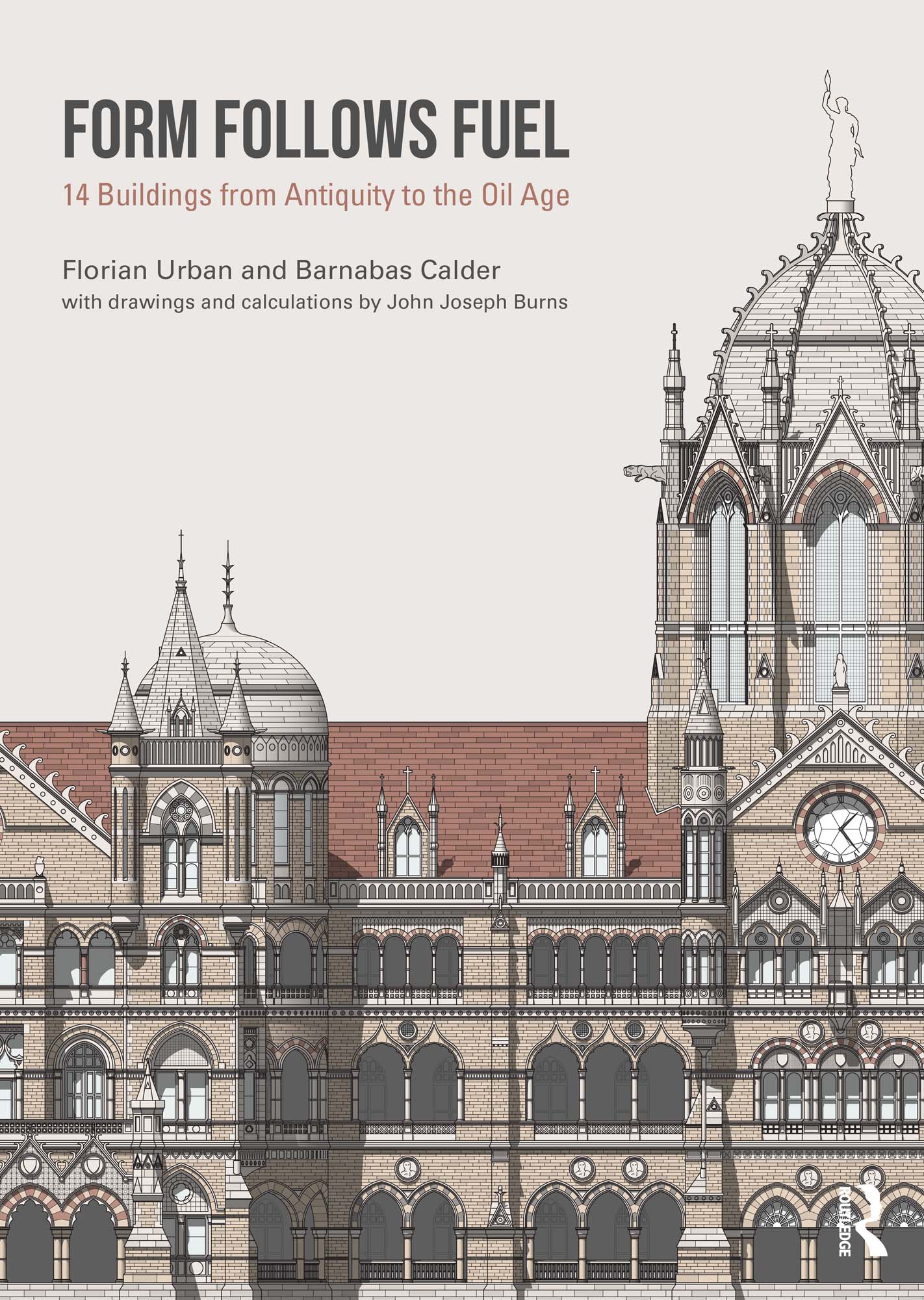
Form follows fuel : 14 buildings from antiquity to the oil age / Florian Urban and Barnabas Calder ; with illustrations and calculations by John Joseph Burns.
Taylor & Francis Available online
View onlineFine Arts Library NA2542.35 .U73 2026
Available
- Format:
- Book
- Author/Creator:
- Urban, Florian, author.
- Calder, Barnabas, author.
- Language:
- English
- Subjects (All):
- Architecture--Environmental aspects--Case studies.
- Architecture.
- Buildings--Energy consumption--Case studies.
- Buildings.
- Architecture--Environmental aspects.
- Buildings--Energy consumption.
- Genre:
- Case studies
- Physical Description:
- 1 online resource
- Other Title:
- Fourteen buildings from antiquity to the oil age
- Place of Publication:
- Abingdon, Oxon ; New York, NY : Routledge, 2026.
- Summary:
- "Modernists believed that "form follows function". Form Follows Fuel shows that in fact energy has been the biggest influence on the world's architecture throughout the history of our species. The availability of energy under different fuel regimes - including human labour, firewood, coal, oil, gas and renewables shapes architecture at all scales, from what gets built to how its doors hinge. The book is the first to quantify energy inputs for a range of buildings worldwide and across the historical record. In the process it throws up both detailed challenges and practical solutions to today's ecological crises, highlighting the aspects of today's buildings that make architecture responsible for 37% of human climate-changing emissions, and revealing the enormously lower impacts of historical alternatives to today's default building practices. The book shows that the shift to fossil fuel, which started in the seventeenth century, came to be the most consequential move in the history of architecture as well as in human history in general. This brought about remarkable wealth for the built environment and at the same time unprecedented dangers for our planet, as evidenced by the exacerbating climate emergency. The book consists of 14 accessibly-written case studies, illustrated with beautiful and revealing new measured drawings of each project by John Joseph Burns. Each chapter focuses on a single structure in a particular historical context, sometimes contrasted to similar buildings, from subsistence farming to advanced global capitalism. The chapters analyse the consumption of embodied and operational energy in these buildings, and also discuss questions of recycling and adaptive reuse. They complement precise descriptions with hard numbers on materials and construction, using robustly-sourced approximations where exact figures are not available. The case studies rely on both published research and the authors' own calculations and allow systematic comparison across different global regions and historical periods. Cases include architectural icons such as the Great Pyramid of Giza, the Baths of Caracalla, the Mausoleum of Qin Shi Huang, the Seagram Building, and Terminal 1 of Kuala Lumpur International Airport, as well as common types such as a pre-modern stone house, a late-nineteenth-century tenement, and a modernist panel block. Examples are taken from different regions of the world, including ancient China, pre-Columbine Mexico, and modern Europe. The book is an important contribution to architectural historical research, written for academics and building professionals as well as for a general audience"-- Provided by publisher.
- Notes:
- Includes bibliographical references and index.
- Description based upon online resource; title from PDF title page (viewed September 16th, 2025).
- Other Format:
- Print version: Urban, Florian. Form follows fuel
- Print version:
- ISBN:
- 9781040402887
- 1040402887
- 9781040402917
- 1040402917
- 9781032637174
- 103263717X
- OCLC:
- 1528568799
- Publisher Number:
- CIPO000261665
- Online:
- Image
The Penn Libraries is committed to describing library materials using current, accurate, and responsible language. If you discover outdated or inaccurate language, please fill out this feedback form to report it and suggest alternative language.