1 option
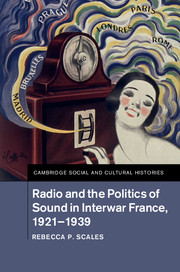
Radio and the politics of sound in interwar France, 1921-1939 / Rebecca Scales.
Lippincott Library HE8697.85.F8 S34 2016
Available
- Format:
- Book
- Author/Creator:
- Scales, Rebecca, 1976- author.
- Series:
- Cambridge social and cultural histories ; 22.
- Cambridge social and cultural histories ; 22
- Language:
- English
- Subjects (All):
- Radio broadcasting--Political aspects--France--History--20th century.
- Radio broadcasting.
- Radio broadcasting--Social aspects--France--History--20th century.
- Sound--Political aspects--France--History--20th century.
- Sound.
- Sound--Social aspects--France--History--20th century.
- Mass media--Political aspects--France--History--20th century.
- Mass media.
- Mass media--Social aspects--France--History--20th century.
- Politics and culture--France--History--20th century.
- Politics and culture.
- Mass media--Social aspects.
- History.
- Mass media--Political aspects.
- Social aspects.
- Radio broadcasting--Social aspects.
- Radio broadcasting--Political aspects.
- France.
- France--Politics and government--1914-1940.
- Politics and government.
- France--Social life and customs--20th century.
- Manners and customs.
- Physical Description:
- ix, 299 pages : illustrations ; 24 cm.
- Place of Publication:
- Cambridge, United Kingdom : Cambridge University Press, 2016.
- Summary:
- "In December of 1921, three years after the Armistice that ended the First World War, a former army radio transmitter on the Eiffel Tower broadcast France's first public radio program, composed of weather and stock bulletins and a short musical concert performed in a rudimentary studio nearby. A decade later, twenty-five state-run and commercial stations were transmitting radio broadcasts across France. Radio had evolved from the pastime of a few tech-savvy wireless amateurs into a mass media capable of reaching millions of listeners. Urban crowds gathered on city streets and in stadia to listen to fiery propaganda speeches broadcast via loudspeaker, schoolchildren clustered around radio receivers in their classrooms, and families tuned in to music and news from the comforts of their living rooms. By 1936, the composer and music critic Emile Vuillermoz could write in the illustrated weekly Le Miroir du monde that French audiences were 'gorging themselves tirelessly in uninterrupted listening to radio, sound films, and the phonograph'"-- Provided by publisher.
- Contents:
- Radio Broadcasting and the Soundscape of Interwar Life
- Disabled Veterans, Radio Citizenship, and the Politics of National Recovery
- Cosmopolitanism and Cacophony : Static, Signals, and the Making of a "Radio Nation"
- Learning by Ear : Popular Front Politics, School Radio, and the Pedagogy of Listening
- Dangerous Airwaves : Propaganda, Surveillance, and the Politics of Listening in French Colonial Algeria
- Conclusion: Paris-Mondial : Globalizing the Voice of France.
- Notes:
- Includes bibliographical references and index.
- Other Format:
- Electronic version: Scales, Rebecca P. Radio and the Politics of Sound in Interwar France, 1921-1939.
- ISBN:
- 9781107108677
- 1107108675
- OCLC:
- 921917320
- Online:
- Cover image
The Penn Libraries is committed to describing library materials using current, accurate, and responsible language. If you discover outdated or inaccurate language, please fill out this feedback form to report it and suggest alternative language.