1 option
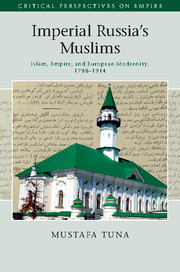
Imperial Russia's Muslims : Islam, empire and European modernity, 1788-1914 / Mustafa Tuna (Duke University).
Van Pelt Library DK511.V65 T86 2015
By Request
- Format:
- Book
- Author/Creator:
- Tuna, Mustafa Özgür, 1976-
- Series:
- Critical perspectives on empire
- Language:
- English
- Subjects (All):
- Muslims--Russia (Federation)--Volga-Ural Region--History.
- Muslims.
- Muslims--Russia (Federation)--Volga-Ural Region--Social conditions.
- Community life--Russia (Federation)--Volga-Ural Region--History.
- Community life.
- Islam--Social aspects--Russia (Federation)--Volga-Ural Region--History.
- Islam.
- Social change--Russia (Federation)--Volga-Ural Region--History.
- Social change.
- Imperialism--Social aspects.
- History.
- Imperialism.
- Islam--Social aspects.
- Social conditions.
- Volga-Ural Region (Russia)--Ethnic relations.
- Volga-Ural Region (Russia).
- Volga-Ural Region (Russia)--Social conditions.
- Muslims--Russia--History.
- Imperialism--Social aspects--Russia--History.
- Russia--History--1801-1917.
- Russia.
- Russia (Federation)--Volga-Ural Region.
- Physical Description:
- xiii, 276 pages ; 24 cm.
- Place of Publication:
- Cambridge, United Kingdom : Cambridge University Press, [2015]
- Summary:
- "Imperial Russia's Muslims offers an exploration of social and cultural change among the Muslim communities of Central Eurasia from the late eighteenth century through to the outbreak of the First World War. Drawing from a wealth of Russian and Turkic sources, Mustafa Tuna surveys the roles of Islam, social networks, state interventions, infrastructural changes and the globalization of European modernity in transforming imperial Russia's oldest Muslim community: the Volga-Ural Muslims. Shifting between local, imperial and transregional frameworks, Tuna reveals how the Russian state sought to manage Muslim communities, the ways in which both the state and Muslim society were transformed by European modernity, and the extent to which the long nineteenth century either fused Russia's Muslims and the tsarist state or drew them apart. The book raises questions about imperial governance, diversity, minorities, and Islamic reform, and in doing so proposes a new theoretical model for the study of imperial situations"-- Provided by publisher.
- Contents:
- A world of Muslims
- 2. Connecting Volga-Ural Muslims to the Russian State
- 3. Russification : unmediated governance and the Empire's quest for ideal subjects
- 4. Peasant responses : protecting the inviolability of the Muslim domain
- 5. Russia's great transformation in the second half of the long nineteenth century (1860-1914)
- 6. The wealthy : prospering with the sea-change and giving back
- 7. The cult of progress
- 8. Alienation of the Muslim intelligentsia
- 9. Imperial paranoia
- 10. Flexibility of the Imperial domain and the limits of integration.
- Notes:
- Includes bibliographical references (pages 244-270) and index.
- ISBN:
- 9781107032491
- 1107032490
- OCLC:
- 900685928
- Online:
- Cover image
The Penn Libraries is committed to describing library materials using current, accurate, and responsible language. If you discover outdated or inaccurate language, please fill out this feedback form to report it and suggest alternative language.