1 option
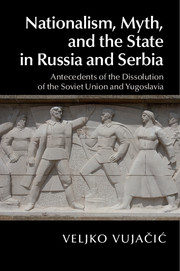
Nationalism, myth, and the state in Russia and Serbia : antecedents of the dissolution of the Soviet Union and Yugoslavia / Veljko Vujačić.
Van Pelt Library DK510.763 .V85 2015
Available
- Format:
- Book
- Author/Creator:
- Vujačić, Veljko, 1962- author.
- Language:
- English
- Subjects (All):
- Weber, Max, 1864-1920.
- Political and social views.
- Elite (Social sciences)--Political activity.
- History.
- Elite (Social sciences).
- Nationalism.
- Myth--Political aspects.
- Myth.
- Russia (Federation)--Politics and government--1991-.
- Russia (Federation).
- Politics and government.
- Serbia--Politics and government--1992-2006.
- Serbia.
- Soviet Union--Politics and government--1985-1991.
- Soviet Union.
- Yugoslavia--Politics and government--1980-1992.
- Yugoslavia.
- Nationalism--Russia (Federation)--History--20th century.
- Myth--Political aspects--History--20th century.
- Nationalism--Serbia--History--20th century.
- Elite (Social sciences)--Political activity--Russia (Federation)--History--20th century.
- Elite (Social sciences)--Political activity--Serbia--History--20th century.
- Weber, Max, 1864-1920--Political and social views.
- Weber, Max.
- Genre:
- History.
- Physical Description:
- xiii, 321 pages ; 24 cm
- Place of Publication:
- New York, NY : Cambridge University Press, 2015.
- Summary:
- "This book examines the role of Russian and Serbian nationalism in different modes of dissolution of the Soviet Union and Yugoslavia in 1991. Why did Russia's elites agree to the dissolution of the Soviet Union along the borders of Soviet republics, leaving twenty-five million Russians outside of Russia? Conversely, why did Serbia's elite succeed in mobilizing Serbs in Croatia and Bosnia for the nationalist cause? Combining a Weberian emphasis on interpretive understanding and counterfactual analysis with theories of nationalism, Veljko Vujačić highlights the role of historical legacies, national myths, collective memories, and literary narratives in shaping diametrically opposed attitudes toward the state in Russia and Serbia. The emphasis on the unintended consequences of communist nationality policy highlights how these attitudes interacted with institutional factors, favoring different outcomes in 1991. The book's postscript examines how this explanation holds up in the light of Russia's annexation of Crimea"-- Provided by publisher.
- Contents:
- Introduction
- 1. Russians and Serbs in the dissolution of the Soviet Union and Yugoslavia : grounds for comparison and alternative explanations
- 2. States, nations, and nationalism : a Weberian view
- 3. Empire, state, and nation in Russia and Serbia
- 4. Communism and nationalism : Russians and Serbs in the Soviet Union and Yugoslavia
- 5. The nation as a community of shared memories and common political destiny : Russians and Serbs in literary narratives
- Conclusion
- Postscript.
- Notes:
- Includes bibliographical references and index.
- ISBN:
- 9781107074088
- 1107074088
- OCLC:
- 903473534
- Online:
- Cover image
The Penn Libraries is committed to describing library materials using current, accurate, and responsible language. If you discover outdated or inaccurate language, please fill out this feedback form to report it and suggest alternative language.