1 option
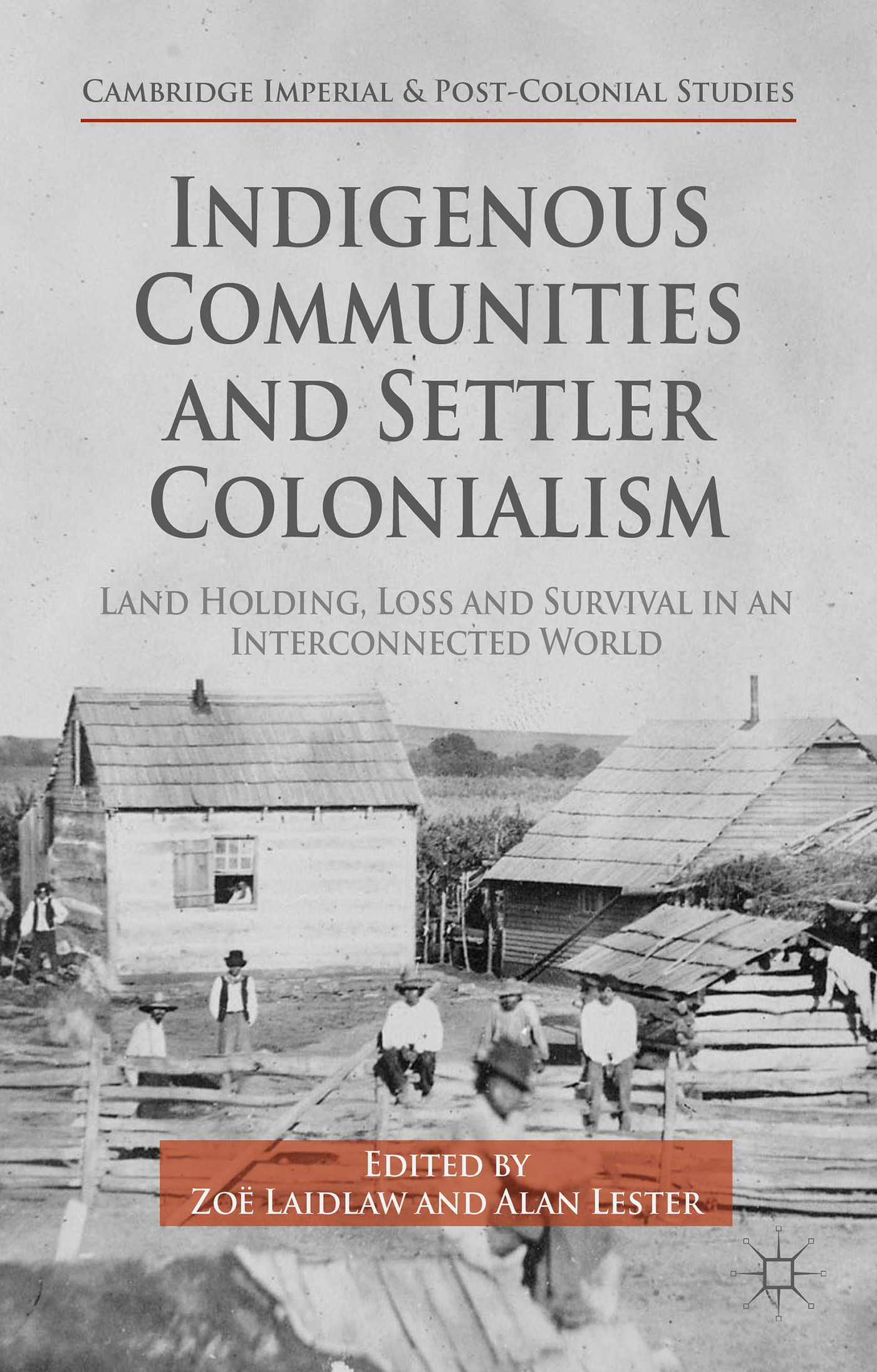
Indigenous communities and settler colonialism : land holding, loss and survival in an interconnected world / edited by Zoë Laidlaw , Reader in British Imperial and Colonial History, Royal Holloway, University of London, UK, andAlan Lester, Professor of Historical Geography, University of Sussex, UK.
Penn Museum Library GN449.3 .I53 2015
Available
- Format:
- Book
- Series:
- Cambridge imperial and post-colonial studies series
- Language:
- English
- Subjects (All):
- Indigenous peoples--Land tenure--History.
- Indigenous peoples.
- Indigenous peoples--Social conditions.
- Colonization--Social aspects--History.
- Colonization.
- Colonists--History.
- Colonists.
- Ethnic relations.
- History.
- Colonization--Social aspects.
- Indigenous peoples--Land tenure.
- Australia--Colonization--History.
- Australia.
- South Africa--Colonization--History.
- South Africa.
- North America--Colonization--History.
- North America.
- Australia--Ethnic relations--History.
- South Africa--Ethnic relations--History.
- North America--Ethnic relations--History.
- Genre:
- History.
- Physical Description:
- xii, 270 pages ; 23 cm.
- Place of Publication:
- Houndmills, Basingstoke, Hampshire : Palgrave Macmillan, 2015.
- Summary:
- "The new world created through Anglophone emigration in the nineteenth century has been much studied. But there have been few accounts of what this world meant for Indigenous communities facing invasion by those emigrants. While settlers in the British Empire and the USA have been seen as participants in newly globalized networks, the Indigenous peoples upon whose lands they settled tend to be seen as rooted, localized, and peripheral to the story of imperial and national expansion. This book weaves through trans-imperial, Indigenous, local and family histories, showing that Indigenous communities tenaciously held land in the midst of dispossession, whilst becoming interconnected through their struggles to do so. Moving between Australia, New Zealand, Canada, South Africa and the USA, it highlights the enduring associations between race, place and behavior in settler societies from Indigenous perspectives"-- Provided by publisher.
- Contents:
- 1. Indigenous Sites and Mobilities : Connected Struggles in the Long Nineteenth Century / Alan Lester and Zoe Laidlaw
- 2. Re-imagining Settler Sovereignty : The Call to Law at the Coranderrk Aboriginal Reserve, Victoria 1881 (and Beyond) / Julie Evans and Giordano Nanni
- 3. Indigenous Land Loss, Justice and Race : Anne Bon and the Contradictions of Settler Humanitarianism / Joanna Cruickshank and Patricia Grimshaw
- 4. "On my ground" : Indigenous Farmers at New Norcia, 1860s-1900 / Tiffany Shellam
- 5. The Possession and Dispossession of the Kat River Settlement / Robert Ross
- 6. Discourses of Land Use, Land Access, and Land Rights at Farmerfield and Loeriesfontein in Nineteenth Century South Africa / Fiona Vernal
- 7. Living on the Rivers' Edge at the Taieri Native Reserve / Angela Wanhalla
- 8. Designing Dispossession : The Select Committee on the Hudsons' Bay Company, Fur-Trade Governance, Indigenous Peoples, and Settler Possibility / Adele Perry
- 9. "They Would Not Give Up One Inch of It" : The Rise and Demise of St. Peter's Reserve, Manitoba / Sarah Carter
- 10. Site of Dispossession, Site of Persistence : The Haudenosaunee (Six Nations) at the Grand River Territory in the Nineteenth and Twentieth Centuries / Cecilia Morgan
- 11. Potawatomi Allotment in Kansas / Kelli Mosteller
- 12. Law, Identity and Dispossession : The Half-Caste Act of 1886 and Contemporary Legal Definitions of Indigeneity in Australia / Mark McMillan and Cosima McRae.
- Notes:
- Includes bibliographical references and index.
- Local Notes:
- Acquired for the Penn Libraries with assistance from the George Clapp Vaillant Book Fund.
- ISBN:
- 9781137452351
- 1137452358
- OCLC:
- 890621999
- Publisher Number:
- 99962880063
- Online:
- Cover image
The Penn Libraries is committed to describing library materials using current, accurate, and responsible language. If you discover outdated or inaccurate language, please fill out this feedback form to report it and suggest alternative language.