1 option
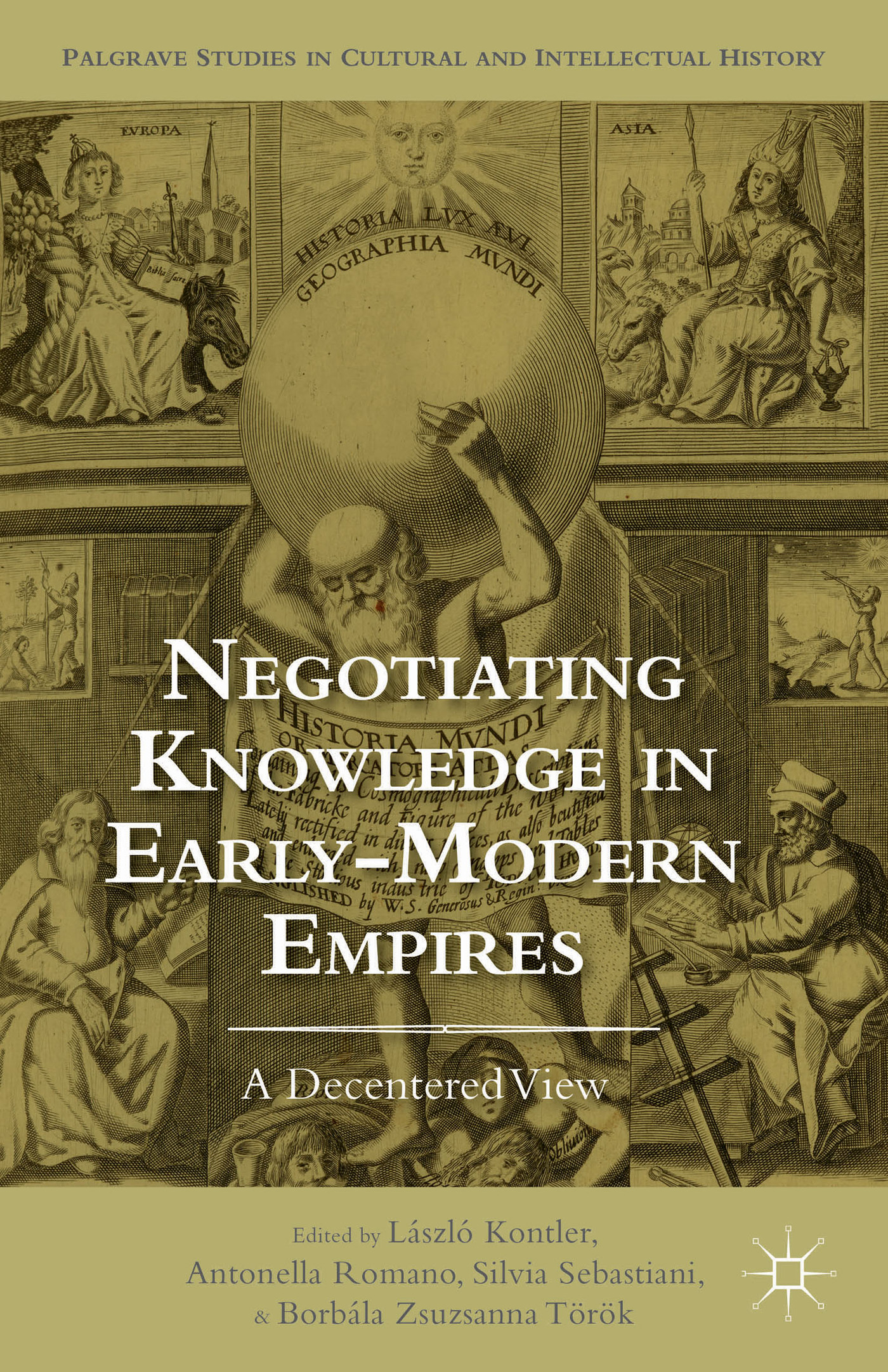
Negotiating knowledge in early modern empires : a decentered view / edited by László Kontler, Antonella Romano, Silvia Sebastiani, and Borbála Zsuzsanna Török.
- Format:
- Book
- Series:
- Palgrave studies in cultural and intellectual history
- Language:
- English
- Subjects (All):
- Science--Europe--History--17th century.
- Science.
- Science--Europe--History--18th century.
- Intellectual life.
- Colonies.
- Imperialism.
- History.
- Europe.
- Science--Asia--History--17th century.
- Science--Asia--History--18th century.
- Knowledge, Theory of--History.
- Knowledge, Theory of.
- Imperialism--History--17th century.
- Imperialism--History--18th century.
- Europe--Intellectual life.
- Europe--Colonies--Intellectual life.
- Asia--Intellectual life.
- Asia.
- Physical Description:
- xiv, 273 pages ; 23 cm.
- Edition:
- First edition.
- Place of Publication:
- New York, NY : Palgrave Macmillan, 2014.
- Summary:
- "The contributions to this volume are united by a common interest in the practices that shaped 'science' in the early modern period, with a special emphasis on the ones bred by the emulation, competition, and conflict that encounters across the globe between different cultural and political entities generated. What it attempts is not simply another contribution to the relatively recent but already respectable tradition of 'science and empire.' Rather than adding further nuance to our understanding of the routes in which the negotiations of knowledge between metropolises and provinces ultimately tended to determine the course of Europe's rise to world hegemony, or of the local dimension of Western knowledge production, the volume takes a 'decentered' look at early modern empires. There are various ways in which such a 'decentering' approach is carried out in the individual contributions. All the chapters deal with European empires, but the angle from which this is pursued has been marked out by the lessons drawn from the non-Eurocentric studies referred to below. This focus is the result of both a contingency and of a state of the art: the contingency derives from the fact that most of the contributors are specialists of European empires; but, on the other side, we may acknowledge with regard to the period under consideration that historiography is still highly unbalanced. This is true not only if we compare European and non-European empires, but also if we pay attention to Europe itself, where the divide between the western and the eastern part of the continent has been overstressed by the 'great divergence' between western and eastern historiographies throughout the twentieth century. To some extent, this is one of the novelties of the volume: it builds upon an unconventional geographical set of cases, embracing the Holy Roman Empire, Spain, as well as China"-- Provided by publisher.
- "The contributions to this volume are united by a common interest in the practices that shaped 'science' in the early modern period, with a special emphasis on the ones bred by the emulation, competition, and conflict that encounters across the globe between different cultural and political entities generated. What it attempts is not simply another contribution to the relatively recent but already respectable tradition of 'science and empire.' Rather than adding further nuance to our understanding of the routes in which the negotiations of knowledge between metropolises and provinces ultimately tended to determine the course of Europe's rise to world hegemony, or of the local dimension of western knowledge production, the volume takes a 'decentered' look at early modern empires. There are various ways in which such a 'decentering' approach is carried out in the individual contributions. All the chapters deal with European empires, but the angle from which this is pursued has been marked out by the lessons drawn from the non-Eurocentric studies referred to below. This focus is the result of both a contingency and of a state of the art: the contingency derives from the fact that most of the contributors are specialists of European empires; but, on the other side, we may acknowledge with regard to the period under consideration that historiography is still highly unbalanced. This is true not only if we compare European and non-European empires, but also if we pay attention to Europe itself, where the divide between the western and the eastern part of the continent has been overstressed by the 'great divergence' between western and eastern historiographies throughout the twentieth century"-- Provided by publisher.
- Contents:
- Introduction / László Kontler, Antonella Romano, Silvia Sebastiani, and Borbála Zsuzsanna Török
- PART I: NEGOTIATION OF (TRANS-)IMPERIAL PATRONAGE
- 1. Was Astronomy the Science of Empires? : an Eighteenth-Century Debate in View of the Cases of Tycho and Galileo / Gábor Almási
- 2. The Jesuits' Negotiation of Science between France and China (1685-1722) : Knowledge and Modes of Imperial Expansion / Catherine Jami
- 3. The Uses of Knowledge and the Symbolic Map of the Enlightened Monarcy of the Habsburgs : Maximilian Hell as Imperial and Royal Astronomer (1755-1792) / László Kontler
- PART II: COMPETITION OF EMPIRES : A MOTOR OF CHANGE IN KNOWLEDGE ACQUISITION AND AUTHENTICATION
- 4. Capitalizing Manuscripts, Confronting Empires : Anquetil-Duperron and the Economy of Oriental Knowledge in the Context of the Seven Years's War / Stéphane Van Damme
- 5. Contested Locations of Knowledge : The Malaspina Expedition along the Eastern Coast of Patagonia (1789) / Marcelo Fabián Figueroa
- 6. "To Round Out this Immense Country" : The Circulation of Cartographic and Historiographical Knowledge from Brazil to Angola / Catarina Madeira-Santos
- PART III: SELF-ASSERTION OF NEW NODES OF KNOWLEDGE PRODUCTION
- 7. Mexico : an American Hub in the Making of European China in the Seventeenth Century / Antonella Romano
- 8. Anthropology beyond Empires : Samuel Stanhope Smith and the Reconfiguration of the Atlantic World / Silvia Sebastiani
- 9. Measuring the Strength of a State : Staatenkunde in Hungary around 1800 / Borbála Zsuzsanna Török.
- Notes:
- Includes bibliographical references and index.
- ISBN:
- 9781137483997
- 1137483997
- OCLC:
- 885910038
- Online:
- Cover image
The Penn Libraries is committed to describing library materials using current, accurate, and responsible language. If you discover outdated or inaccurate language, please fill out this feedback form to report it and suggest alternative language.