1 option
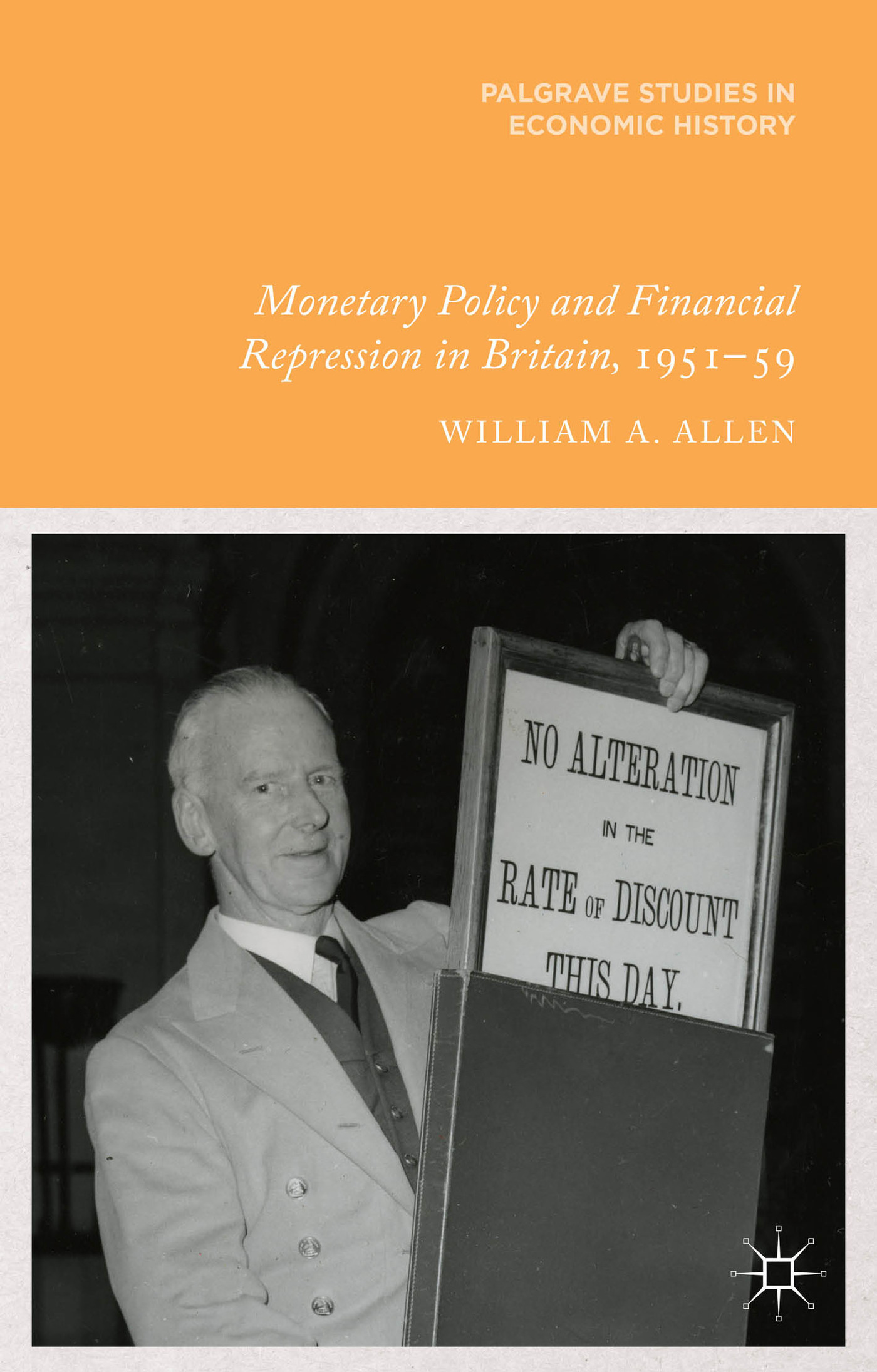
Monetary policy and financial repression in Britain, 1951-59 / William A. Allen.
- Format:
- Book
- Author/Creator:
- Allen, Bill, 1949- author.
- Series:
- Palgrave studies in economic history
- Palgrave studies in economic history series
- Language:
- English
- Subjects (All):
- Monetary policy--Great Britain--History--20th century.
- Monetary policy.
- Fiscal policy--Great Britain--History--20th century.
- Fiscal policy.
- Debts, Public--Great Britain--History--20th century.
- Debts, Public.
- Economic policy.
- History.
- Great Britain--Economic policy--20th century.
- Great Britain.
- Physical Description:
- xii, 287 pages ; 23 cm.
- Place of Publication:
- Houndmills, Basingstoke, Hampshire : Palgrave Macmillan, 2014.
- Summary:
- "Following the end of the Second World War, Britain enjoyed a period of prosperity and rapid growth in the 1950s. British monetary policy was reactivated by the newly-elected Conservative government in 1951 when short-term interest rates were increased for the first time in nearly two decades. However, inflation was a recurrent problem and there were repeated sterling crises. This text explores the politics of formulating monetary policy in the 1950s and the techniques of implementing it, and discusses the parallels between the present monetary situation and that of 1951. Drawing on official archives, this study describes how monetary policy was decided on, implemented and communicated at a time when the government was struggling with massive post-war debts while maintaining welfare and military spending and cutting taxes. It discusses the roles of the Governor of the Bank of England, Cameron Cobbold, and of successive Chancellors R.A. Butler, Harold Macmillan, Peter Thorneycroft and Derick Heathcoat Amory, and Macmillan's continued dominance of monetary policy after he became Prime Minister. It explains the intimate relationships between monetary policy, government debt management and fiscal policy, and the use of 'financial repression'. Monetary Policy and Financial Repression in Britain, 1951-59 provides an insightful view into Britain's economy in the 1950s and is essential reading for students, researchers and scholars of British history and economics"-- Provided by publisher.
- Contents:
- Machine generated contents note:
- 1. Introduction
- 2. 1945-51:Labour's Macro-economic Policies
- 3. 1951-52: the Reactivation of Monetary Policy
- 4. 1952-54: Years of Growth
- 5. Moves Towards Convertibility and their Implications for Monetary Policy
- 6. Short-term Interest Rates in Late 1952
- Mid-1954
- 7. Government Debt Management 1952-54
- 8. The Debacle of 1955
- 9. 1956: Macmillan as Chancellor
- 10. 1957: the Year of Thorneycroft
- 11. 1958: the Sunny Uplands
- 12. 1959: Here We Go Again
- 13. Monetary Policy Techniques
- 14. Financial Repression
- 15. Management and Communication of Monetary Policy
- 16. An Assessment of Monetary Policy
- 17. Epilogue: the Next Reactivation of Monetary Policy.
- Notes:
- Includes bibliographical references and index.
- ISBN:
- 9781137383815
- 113738381X
- OCLC:
- 881659710
- Online:
- Cover image
The Penn Libraries is committed to describing library materials using current, accurate, and responsible language. If you discover outdated or inaccurate language, please fill out this feedback form to report it and suggest alternative language.