1 option
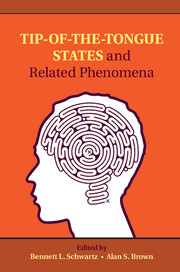
Tip-of-the-tongue states and related phenomena / edited by Bennett L. Schwartz, Florida International University, Alan S. Brown, Southern Methodist University.
- Format:
- Book
- Language:
- English
- Subjects (All):
- Memory disorders.
- Metacognition.
- Recollection (Psychology).
- Physical Description:
- viii, 356 pages : illustrations ; 24 cm
- Place of Publication:
- New York : Cambridge University Press, 2014.
- Summary:
- "When the memory retrieval process breaks down, people wonder exactly why and how such a thing occurs. In many cases, failed retrieval is accompanied by a "tip-of-the-tongue state," a feeling that an unretrieved item is stored in memory. Tip-of-the-tongue states stand at the crossroads of several research traditions within cognitive science. Some research focuses on the nature of the retrieval failure. Other research tries to determine what tip-of-the-tongue states can tell us about the organization of lexical memory - that is, what aspects of a word we can recall when we are otherwise unable to do so. Still other research focuses on the nature of the experience of a tip-of-the-tongue state. Each of these perspectives is represented in this book, which presents the best theoretical and empirical work on these subjects. Much of the work is cross-disciplinary, but what unifies the topics in this book is that they concern strong phenomenological states of knowing that are not accompanied by recall or recognition of the desired information"-- Provided by publisher.
- Contents:
- Machine generated contents note: 1. Why tip of the tongue states are important Alan S. Brown and Bennett L. Schwartz; 2. Tip of the tongue (TOT) states: mechanisms and metacognitive control Bennett L. Schwartz and Janet Metcalfe; 3. There it is again on my tongue: tracking repeat TOTs Alan S. Brown and Katie Croft Caderao; 4. Retrieval failures for the names of familiar people J. Richard Hanley; 5. The effect of tip of the tongue states on other cognitive judgments Anne M. Cleary, Shelly R. Staley and Kimberly R. Klein; 6. Why the journey to a word takes you no closer Trevor A. Harley; 7. Tip of the tongue in mild cognitive impairment (MCI) Onésimo Juncos-Rabadán, David Facal and Arturo X. Pereiro; 8. Metamemory and Parkinson's disease Justin D. Oh-Lee and Hajime Otani; 9. Psychopharmacological approach of the metamemory and TOT phenomenon Marie Izaute and Elisabeth Bacon; 10. Neurofunctional correlates of the tip of the tongue state Fernando Díaz, Mónica Lindín, Santiago Galdo-Alvarez and Ana Buján; 11. The blank in the mind experience: another manifestation of tip of the tongue state or something else? Anastasia Efklides; 12. On the empirical study of déjà vu: borrowing methodology from the study of the tip of the tongue phenomenon Anne M. Cleary; 13. Déjà vu in older adults Chris J. A. Moulin, Celine Souchay, Sarah Buchanan, Rosemary Bradley, Dilay Zeynep Karadoller and Melisa Akan; 14. Odor knowledge, odor naming, and the 'tip of the nose' experience Frederik U. Jönsson and Richard J. Stevenson; 15. What do we know when we forget? Asher Koriat and Ravit Nussinson.
- Notes:
- Includes bibliographical references and indexes.
- ISBN:
- 9781107035225
- 1107035228
- OCLC:
- 872253753
- Online:
- Cover image
The Penn Libraries is committed to describing library materials using current, accurate, and responsible language. If you discover outdated or inaccurate language, please fill out this feedback form to report it and suggest alternative language.