1 option
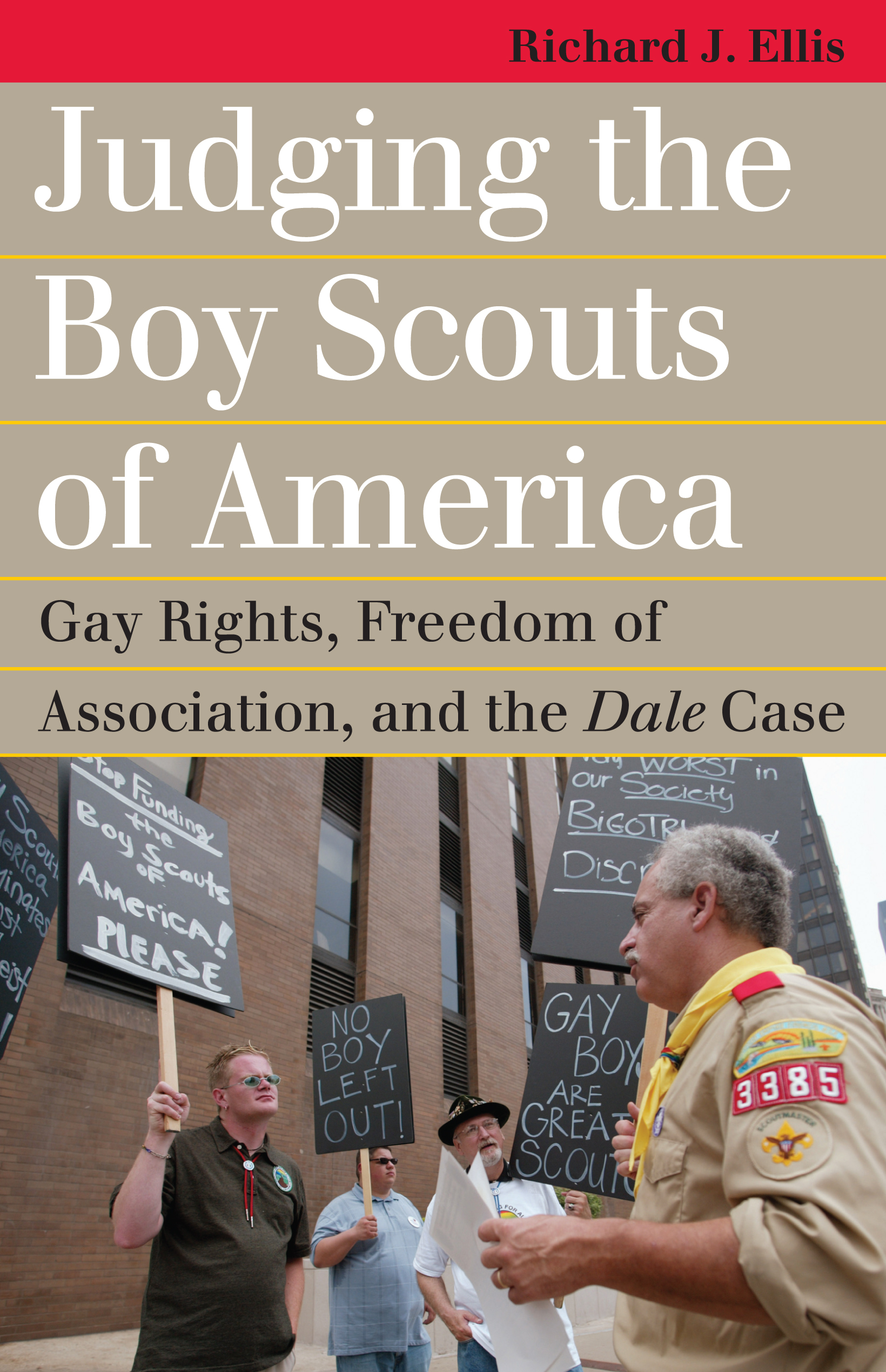
Judging the Boy Scouts of America : gay rights, freedom of association, and the Dale case / Richard J. Ellis.
Van Pelt Library KF229.D35 E43 2014
Available
- Format:
- Book
- Author/Creator:
- Ellis, Richard (Richard J.), author.
- Series:
- Landmark law cases & American society
- Language:
- English
- Subjects (All):
- Dale, James, 1970---Trials, litigation, etc.
- Dale, James.
- Dale, James, 1970-.
- Boy Scouts of America--Trials, litigation, etc.
- Boy Scouts of America.
- Freedom of association--United States.
- Freedom of association.
- Boy Scouts.
- Homophobia--Law and legislation.
- United States.
- Homophobia--Law and legislation--United States.
- Homophobia.
- Boy Scouts--Legal status, laws, etc--United States.
- Gay people--Legal status, laws, etc--United States.
- Gay people.
- Gay people--Legal status, laws, etc.
- Physical Description:
- xii, 286 pages ; 23 cm.
- Place of Publication:
- Lawrence, Kansas : University Press of Kansas, [2014]
- Summary:
- "As Americans, we cherish the freedom to associate. However, with the freedom to associate comes the right to exclude those who do not share our values and goals. What happens when the freedom of association collides with the equally cherished principle that every individual should be free from invidious discrimination? This is precisely the question posed in Boy Scouts of America v. James Dale, a lawsuit that made its way through the courts over the course of a decade, culminating in 2000 with a landmark ruling by the U.S. Supreme Court. In Judging the Boy Scouts of America, Richard J. Ellis tells the fascinating story of the Dale case, placing it in the context of legal principles and precedents, Scouts policies, gay rights, and the "culture wars" in American politics. The story begins with James Dale, a nineteen-year old Eagle Scout and assistant scoutmaster in New Jersey, who came out as a gay man in the summer of 1990. The Boy Scouts, citing their policy that denied membership to "avowed homosexuals," promptly terminated Dale's membership. Homosexuality, the Boy Scout leadership insisted, violated the Scouts' pledge to be "morally straight." With the aid of the Lambda Legal Defense Fund, Dale sued for discrimination. Ellis tracks the case from its initial filing in New Jersey through the final decision of the U.S. Supreme Court in favor of the Scouts. In addition to examining the legal issues at stake, including the effect of the Supreme Court's ruling on the law of free association, Ellis also describes Dale's personal journey and its intersection with an evolving gay rights movement. Throughout he seeks to understand the puzzle of why the Boy Scouts would adopt and adhere to a policy that jeopardized the organization's iconic place in American culture--and, finally, explores how legal challenges and cultural changes contributed to the Scouts' historic policy reversal in May 2013 that ended the organization's ban on gay youth (though not gay adults)"-- Provided by publisher.
- Contents:
- Introduction. Freedom of association and the right to exclude
- The model boy scout
- In Dale's defense
- The three Gs
- The culture wars
- Dale's case begins
- The Scouts' response
- Judging an "active sodomist"
- Eradicating the "cancer of discrimination"
- A unanimous court
- Preparing for the Supreme Court
- On the supreme stage
- A decision is announced
- Backlash
- Freedom of association after Dale
- Epilogue. "The wrong side of history"
- Notes:
- Includes bibliographical references and index.
- ISBN:
- 9780700619504
- 070061950X
- 9780700619511
- 0700619518
- OCLC:
- 864095903
- Online:
- Cover image
The Penn Libraries is committed to describing library materials using current, accurate, and responsible language. If you discover outdated or inaccurate language, please fill out this feedback form to report it and suggest alternative language.