1 option
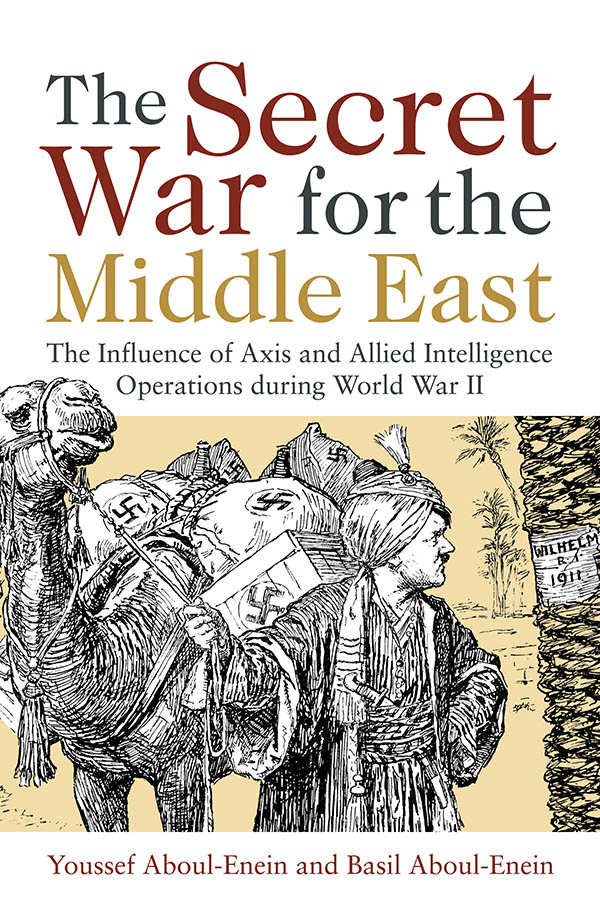
The secret war for the Middle East : the influence of Axis and Allied intelligence operations during World War II / Youssef Aboul-Enein and Basil Aboul-Enein.
- Format:
- Book
- Author/Creator:
- Aboul-Enein, Youssef H.
- Language:
- English
- Subjects (All):
- World War, 1939-1945--Middle East.
- World War, 1939-1945.
- World War, 1939-1945--Secret service--Middle East.
- World War, 1939-1945--Influence.
- Middle East--Politics and government--1914-1945.
- Middle East.
- Politics and government.
- Genre:
- Biographies.
- Physical Description:
- xxiii, 263 pages : maps ; 25 cm
- Place of Publication:
- Annapolis, Maryland : Naval Institute Press, [2013]
- Summary:
- "It can be argued that the Middle East during the World War II has been regarded as that conflict's most overlooked theater of operations. Though the threat of direct Axis invasion never materialized beyond the Egyptian Western Desert with Rommel's Afrika Korps, this did not limit the Axis from probing the Middle East and cultivating potential collaborators and sympathizers. These actions left an indelible mark in the socio-political evolution of the modern states of the Middle East. This book explores the infusion of the political language of anti-Semitism, nationalism, fascism, and Marxism that were among the ideological byproducts of Axis and Allied intervention in the Arab world. The status of British-dominated Middle East was tailor-made for exploitation by Axis intelligence and propaganda. German and Italian intelligence efforts fueled anti-British resentments; their influence shaped the course of Arab nationalist sentiments throughout the Middle East. A relevant parallel to the pan-Arab cause was Hitler's attempt to bring ethnic Germans into the fold of a greater German state. In theory, as the Sudeten German stood on par with the Carpathian German, so too, according to doctrinal theory, did the Yemeni stand in union with the Syrian in the imagination of those espousing pan-Arabism. As historic evidence demonstrates, this very commonality proved to be a major factor in the development of relations between Arab and Fascist leaders. The Arab nationalist movement amounted to nothing more than a shapeless, fragmented, counter position to British imperialism, imported to the Arab East via Berlin for Nazi aspirations"-- Provided by publisher.
- Notes:
- Includes bibliographical references and index.
- Other Format:
- Online version: Aboul-Enein, Youssef H. Secret war for the Middle East
- ISBN:
- 9781612513096
- 1612513093
- OCLC:
- 854285785
- Online:
- Cover image
The Penn Libraries is committed to describing library materials using current, accurate, and responsible language. If you discover outdated or inaccurate language, please fill out this feedback form to report it and suggest alternative language.