1 option
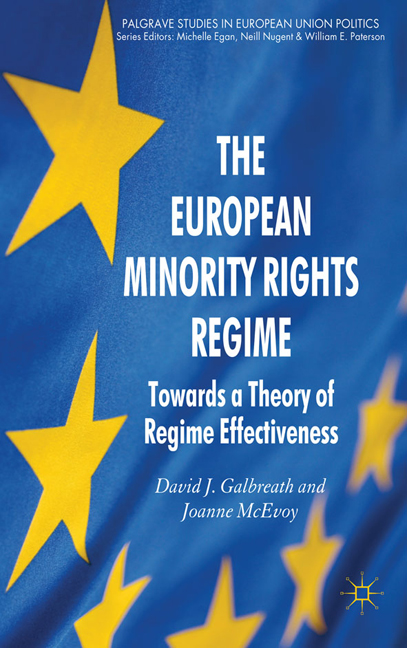
The European minority rights regime : towards a theory of regime effectiveness / David J. Galbreath, Joanne McEvoy.
- Format:
- Book
- Author/Creator:
- Galbreath, David J.
- Series:
- Palgrave studies in European Union politics
- Language:
- English
- Subjects (All):
- Minorities--Government policy--Europe.
- Minorities.
- Minorities--Civil rights--Europe.
- Minorities--Civil rights.
- Minorities--Government policy.
- Europe--Ethnic relations.
- Europe.
- Ethnic relations.
- Physical Description:
- xiii, 213 pages ; 23 cm.
- Place of Publication:
- Houndmills, Basingstoke ; New York : Palgrave Macmillan, 2012.
- Summary:
- The European Minority Rights Regime investigates the cooperation between the EU, OSCE and Council of European on minority rights in Europe. It tracks the formation and transformation of this international regime and questions its effectiveness in securing minority rights. The book demonstrates how the three organizations have formalized their linkages and managed their respective mandates in the context of EU enlargement. At the domestic level, the book focuses on three case studies - Latvia, Romania and Bulgaria - with an examination of the impact of inter-organizational cooperation on the status of their respective national minorities. Although cooperation has delivered largely positive change for accession countries, challenges remain for minorities in Europe and the regime's future operation. This book links two key research areas - international regimes and EU integration - to determine why ethnic politics remain a source of contention for the European project. Book jacket.
- Contents:
- Chapter 1 Introduction 1
- 1.1 A regime theory approach 4
- 1.2 Methodology 6
- 1.3 Structure of the book 6
- 1.4 The argument 10
- Chapter 2 The Role of Regimes in Post-War Europe 12
- 2.1 International regimes: From formation to effects 13
- 2.2 The post-war human rights regime 15
- 2.3 From human rights to the European minority rights regime 17
- 2.4 Theoretical approaches to regime formation: Interests, power and knowledge 19
- 2.5 The explanatory potential and limits of interests, power and knowledge 27
- 2.6 European integration debates; Enlargement and conditionality 31
- 2.7 Conclusions 35
- Chapter 3 Explaining Regime Effectiveness 37
- 3.1 Dependent variable: Regime effectiveness 3 7
- 3.2 Independent variables 41
- 3.3 Case studies 52
- Chapter 4 The European Minority Rights Regime 54
- 4.1 Origin of the minority rights regime 55
- 4.2 Origins of the minority rights discourse in Europe 59
- 4.3 Building the minority rights regime 64
- 4.4 After enlargement 80
- Chapter 5 The Influence of International Organizations 81
- 5.1 The impact of European minority rights norms 82
- 5.2 A gap between norms and reality? 92
- 5.3 Evaluating mechanisms: I0 incentives and persuasion 100
- 5.4 Conclusions 110
- Chapter 6 Interorganizational Overlap and Minority Rights 112
- 6.1 Conceptualizing overlap 114
- 6.2 Overlap as enhanced cooperation 116
- 6.3 Overlap as a constraint on regime effectiveness? 134
- 6.4 Conclusions 139
- Chapter 7 International Regimes and State Implementation 142
- 7.1 Minorities during and after communism 145
- 7.2 Agents of support and opposition 150
- 7.3 Host-kin-state relations 155
- 7.4 Limits of implementation 162
- 7.5 Conclusions 170
- Chapter 8 An Effective International Regime? 173
- 8.1 European minority rights norms 176
- 8.2 Regime mechanisms 180
- 8.3 IO overlap and regime effectiveness 182
- 8.4 State implementation 184
- 8.5 After enlargement 186
- 8.6 Implications for international regime theory 188
- 8.7 Remaining questions and further research 190.
- Notes:
- Includes bibliographical references and index.
- ISBN:
- 9780230236462
- 0230236464
- OCLC:
- 748328882
- Online:
- Cover image
The Penn Libraries is committed to describing library materials using current, accurate, and responsible language. If you discover outdated or inaccurate language, please fill out this feedback form to report it and suggest alternative language.