1 option
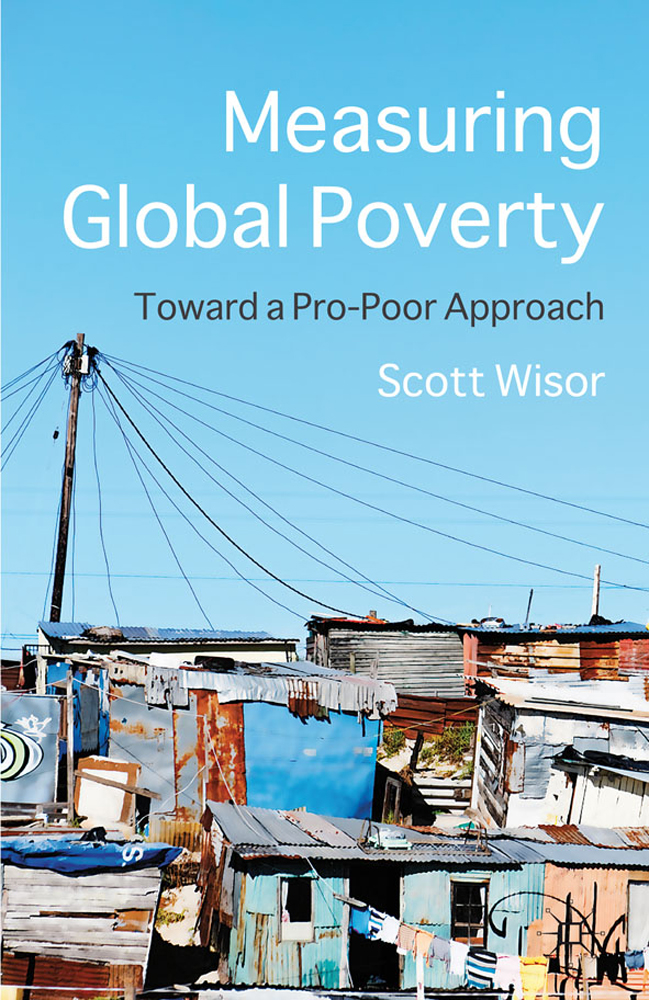
Measuring global poverty : toward a pro-poor approach / Scott Wisor, Australian National University, Australia.
Lippincott Library HC79.P6 W57 2012
Available
- Format:
- Book
- Author/Creator:
- Wisor, Scott, 1981-
- Language:
- English
- Subjects (All):
- Poverty--Measurement.
- Poverty.
- Physical Description:
- xiii, 241 p . ; 18 cm
- Place of Publication:
- New York : Palgrave Macmillan, 2012.
- Summary:
- Global poverty measurement is important it is used to allocate scarce resource evaluate progress and existing projects, policies, and institutional designs. Hot given the diversity of ways in which poverty conceived, how can we settle one conception and measure that can be used for interpersonal and intertemporal global comparison?
- This book days out the key contemporary debates in poverty measurement, and provides new analytical framework for thinking about poverty conception and measurement Rather than trying some essential meaning of poverty the author recommends explicity reflecting on the purposes served by the concept and the values that do and should inform our concept and measures.
- After review the strengths and weaknesses of five competing conceptions of poverty and their corresponding measures the book concludes with specific recommendations or the poverty measurement should be developed through process or public reason that gives weight to the voice of those individuals who are most and the another suggest new desiderate and indicate indicators should be used in a pro poverty measure. Book jacket.
- Contents:
- Part I A Framework for Analyzing Poverty
- 1 Introducing Poverty Measurement 3
- 1.1 Introduction 3
- 1.2 Why poverty measurement matters 6
- 1.3 For whom does poverty measurement matter? 8
- 1.4 Different measures produce (very) different assessments 9
- 1.5 The components of a poverty measure 12
- 1.6 The key conceptual questions in poverty measurement 14
- 1.7 Existing desiderata for poverty measures 16
- 1.8 What poverty might be and is not 18
- 1.9 Recent developments 19
- 1.10 The rest of the book 21
- 2 A Defense of Global Poverty Measurement 23
- 2.1 The initial desirability of global poverty measurement 23
- 2.2 Objection 1: poverty measurement is (and should be) subject to domestic deliberation 24
- 2.3 Objection 2: global poverty measurement entails cosmopolitanism or global redistribution 26
- 2.4 Objection 3: global poverty measurement is homogenizing 27
- 2.5 Objection 4: problematic rank seeking behavior 29
- 2.6 A qualified defense of composite indices 31
- 2.7 Balancing global poverty measurement with local needs 34
- 2.8 Conclusion 35
- 3 A Pro-Poor Methodology 37
- 3.1 Is poverty analysis question begging? 37
- 3.2 Poverty as essentially contestable 40
- 3.3 Haslanger's three approaches to conceptual analysis 46
- 3.4 Objections to an ameliorative approach 51
- 3.5 Conclusion 56
- Part II Competing Conceptions arid Measures of Poverty
- 4 Monetary Approaches 59
- 4.1 Income and consumption-expenditure 59
- 4.2 Strengths of the monetary approach 60
- 4.3 Weaknesses of the income approach 61
- 4.4 The World Bank's International Poverty Line 63
- 4.5 Critique I: technical and conceptual issues 66
- 4.6 Critique II: further charges against the IPL 69
- 4.7 Conclusion 75
- 5 Basic Needs 77
- 5.1 Basic needs and poverty 78
- 5.2 The basic needs approach critiqued and defended 83
- 5.3 The measurement of basic needs deprivation 86
- 5.4 The strengths of basic needs measurement 88
- 5.5 The weaknesses of basic needs measurement 88
- 5.6 Conclusion 89
- 6 Capabilities 91
- 6.1 Welfare, resources, and capabilities 92
- 6.2 Poverty as capabilities deprivation 95
- 6.3 Resources and capabilities revisited 97
- 6.4 Capabilities measurement 100
- 6.5 The multidimensional poverty index 100
- 6.6 The MPI critiqued 103
- 6.7 Conclusion 110
- 7 Social Exclusion 111
- 7.1 History and current use 111
- 7.2 Poverty and social exclusion 113
- 7.3 Social exclusion measurement 115
- 7.4 Strengths 117
- 7.5 Weaknesses 120
- 7.6 Conclusion 122
- 8 Rights 123
- 8.1 Rights defined 124
- 8.2 Rights justified 124
- 8.3 Anti-poverty rights 125
- 8.4 Challenges to anti-poverty rights 127
- 8.5 Rights based poverty measurement 133
- 8.6 Remaining challenges 139
- 8.7 Conclusion 140
- Part III The Way Forward
- 9 New Values, New Desiderata 145
- 9.1 Values 145
- 9.2 Horizontal equity 152
- 9.3 Agency 155
- 9.4 Contextualism 157
- 9.5 Serves the legitimate interests of affected people 160
- 9.6 Individual as unit of analysis 160
- 9.7 Capable of revealing group-based disparity 161
- 9.8 Cross-culturally sharable and applicable 162
- 9.9 Can be used by and for poor people 163
- 9.10 Responsive to different needs 163
- 9.11 Reflective of quality 163
- 9.12 Conclusion 164
- 10 Public Reason and Poverty Measurement 165
- 10.1 Essential contestability and the endless dispute 165
- 10.2 The role of participation 166
- 10.3 The critique of participation 169
- 10.4 Participatory processes and poverty measurement 170
- 10.5 The role of public reason in global poverty measurement 174
- 10.6 Public reason and the post-2015 development framework 176
- 10.7 Conclusion 180
- 11 Toward Pro-Poor Global Poverty Measurement 181
- 11.1 Complementarity in data collection and presentation 181
- 11.2 Dimensions for consideration 184
- 11.3 Panel data and survey data 189
- 11.4 Measuring vulnerability and risk 190
- 11.5 Bringing about change: political will for pro-poor measurement 192
- 11.6 A note of caution 195
- 11.7 Better measurement in a post-2015 world? 195.
- Notes:
- Includes bibliographical references and index.
- ISBN:
- 9780230302860
- 0230302866
- OCLC:
- 765880797
- Online:
- Cover image
The Penn Libraries is committed to describing library materials using current, accurate, and responsible language. If you discover outdated or inaccurate language, please fill out this feedback form to report it and suggest alternative language.