1 option
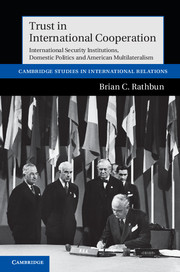
Trust in international cooperation : international security institutions, domestic politics and American multilateralism / Brian C. Rathbun.
Van Pelt Library JZ1318 .R375 2012
By Request
- Format:
- Book
- Author/Creator:
- Rathbun, Brian C., 1973-
- Series:
- Cambridge studies in international relations ; 121.
- Cambridge studies in international relations ; 121
- Language:
- English
- Subjects (All):
- International cooperation.
- International organization.
- Physical Description:
- xiv, 253 pages ; 24 cm.
- Place of Publication:
- Cambridge, U.K. ; New York : Cambridge University Press, [2012]
- Summary:
- "Trust in International Cooperation challenges conventional wisdoms concerning the part which trust plays in international cooperation and the origins of American multilateralism. Rathbun questions rational institutionalist arguments, demonstrating that trust precedes rather than follows the creation of international organizations. Drawing on social psychology, he shows that individuals placed in the same structural circumstances show markedly different propensities to cooperate based on their beliefs about the trustworthiness of others. Linking this finding to political psychology, Rathbun explains why liberals generally pursue a more multilateral foreign policy than conservatives, evident in the Democratic Party's greater support for a genuinely multilateral League of Nations, United Nations and North Atlantic Treaty Organization. Rathbun argues that the post-Second World War bipartisan consensus on multilateralism is a myth, and differences between the parties are growing continually starker"--Provided by publisher.
- "In 2001, even before the terrible events of 9/11, a term once reserved for arcane discussions among academics began to seep into the public discourse - unilateralism. This was the characterization of a number of high-profile actions taken by the new Republican administration such as the "unsigning" of the International Criminal Court statute and a lack of serious engagement on the issue of climate change. Following the terrorist attacks in New York and Washington, the Bush administration decided to fight the war in Afghanistan largely alone, refusing an offer of NATO help. Then, of course, came Iraq. The American government, unable to garner the international community's endorsement of its aim of permanently disarming Saddam Hussein's regime by force, proceeded without the sanction of the United Nations. The government's unilateralism, it has been consistently maintained, marked a departure from the post-WWII tradition of American multilateral engagement and has attracted widespread disappointment and scorn on the part of American allies. Even as the Bush administration was brandished for being unilateral, however, scholars and pundits alike failed to interrogate the term and its logical opposite - multilateralism. What are unilateralism and multilateralism and what are their sources? A convenient answer is that unilateralism is the desire to go it alone, one that simply emerges when a state's interests are out of line with those of other countries. Why, after all, would the United States seek to constrain itself multilaterally in the United Nations when other countries were not as threatened by the possibility of weapons of mass destruction falling into terrorists' hands?"--Provided by publisher.
- Contents:
- Circles of trust : reciprocity, community and multilateralism
- Anarchical social capital: a social psychological theory of international cooperation and institutional design
- The open circle : the failure of the League of Nations
- Squaring the circle : the birth of the United Nations
- Closing the circle : the negotiation of the North Atlantic Treaty
- Coming full circle : fear, terrorism and the future of American multilateralism.
- Notes:
- Includes bibliographical references (pages 229-248) and index.
- ISBN:
- 9781107014718
- 1107014719
- 9781107603769
- 1107603765
- OCLC:
- 746619354
- Online:
- Cover image
The Penn Libraries is committed to describing library materials using current, accurate, and responsible language. If you discover outdated or inaccurate language, please fill out this feedback form to report it and suggest alternative language.