1 option
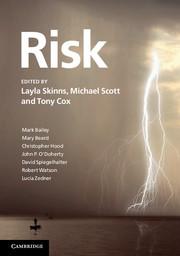
Risk / edited by Layla Skinns, Michael Scott and Tony Cox.
- Format:
- Book
- Series:
- Darwin College lectures ; 24.
- The Darwin College lectures ; 24
- Language:
- English
- Subjects (All):
- Risk--Sociological aspects.
- Risk.
- Risk perception.
- Risk assessment.
- Genre:
- Aufsatzsammlung.
- Physical Description:
- xii, 189 pages : illustrations ; 25 cm.
- Place of Publication:
- Cambridge, UK ; New York : Cambridge University Press, 2011.
- Summary:
- "Recent events from the economic downturn to climate change mean that there has never been a better time to be thinking about and trying to better understand the concept of risk. In this book, prominent and eminent speakers from fields as diverse as statistics to classics, neuroscience to criminology, politics to astronomy, as well as speakers embedded in the media and in government have put their ideas down on paper in a series of essays that broaden our understanding of the meaning of risk. After twenty-five years, the prestigious Darwin College Lectures are one of the most popular public lecture series at the University of Cambridge. The risk lectures in 2010 were amongst the most popular yet and, in essay form, they make for a lively and engaging read for specialists and non-specialists alike"-- Provided by publisher.
- Contents:
- Machine generated contents note: 1. Introduction Layla Skinns, Michael Scott and Tony Cox; 2. Quantifying uncertainty David Spiegelhalter; 3. Decisions, risk and the brain John P. O'Doherty; 4. Risk and government: the architectonics of blame avoidance Christopher Hood; 5. Risk and the humanities: alea iacta est Mary Beard; 6. Terrorism and counterterrorism: what is at risk? Lucia Zedner; 7. Risk and natural catastrophes: the long view Mark Bailey; 8. Risk in the context of (human-induced) climate change Robert Watson.
- Notes:
- Includes bibliographical references and index.
- ISBN:
- 9780521171977
- 0521171970
- OCLC:
- 714729271
- Online:
- Cover image
The Penn Libraries is committed to describing library materials using current, accurate, and responsible language. If you discover outdated or inaccurate language, please fill out this feedback form to report it and suggest alternative language.