1 option
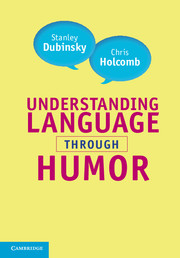
Understanding language through humor / Stanley Dubinsky and Chris Holcomb.
- Format:
- Book
- Author/Creator:
- Dubinsky, Stanley, 1952-
- Language:
- English
- Subjects (All):
- Linguistics.
- Wit and humor.
- Physical Description:
- ix, 202 pages : illustrations ; 25 cm
- Place of Publication:
- Cambridge, UK ; New York : Cambridge University Press, 2011.
- Summary:
- "Students often struggle to understand linguistic concepts through examples of language data provided in class or in texts. Presented with ambiguous information, students frequently respond that they do not 'get it'. The solution is to find an example of humour that relies on the targeted ambiguity. Once they laugh at the joke, they have tacitly understood the concept, and then it is only a matter of explaining why they found it funny. Utilizing cartoons and jokes illustrating linguistic concepts, this book makes it easy to understand these concepts, while keeping the reader's attention and interest. Organized like a course textbook in linguistics, it covers all the major topics in a typical linguistics survey course, including communication systems, phonetics and phonology, morphemes, words, phrases, sentences, language use, discourses, child language acquisition and language variation, while avoiding technical terminology"-- Provided by publisher.
- "Former Hooters waitress settles toy Yoda suit PANAMA CITY, Fla. (AP) - A former waitress has settled her lawsuit against Hooters, the restaurant that gave her a toy Yoda doll instead of the Toyota she thought she had won. Jodee Berry, 27, won a beer sales contest last May at the Panama City Beach Hooters. She believed she had won a new Toyota and happily was escorted to the restaurant's parking lot in a blindfold. But when the blindfold was removed, she found she had won a new toy Yoda - the little green character from the Star Wars movies. David Noll, her attorney, said Wednesday that he could not disclose the settlement's details, although he said Berry can now go to a local car dealership and "pick out whatever type of Toyota she wants."1 If you appreciate the pun behind the practical joke that led to this lawsuit, then you've understood, at least on some level, the linguistic features upon which it hinges. First of all, the company name Toyota and the two-word phrase toy Yoda both have stress on the second syllable "yo". In addition to that, the t sound in Toyota is produced sounding much like a d when it occurs between two vowels (such as o and a). The result is that both sound nearly identical when pronounced in normal, conversational, rapid speech. This is not just a fact about these two expressions. "-- Provided by publisher.
- Contents:
- Machine generated contents note: 1. Introduction; 2. Talking to Garfield: human and animal communication; 3. Did I hear that right? The sounds of language; 4. Twisted words: word structure and meaning; 5. Fitting words together: phrase structure and meaning; 6. Meaning one thing and saying another: indirect speech and conversational principles; 7. Fitting the pieces together: the structure of discourse; 8. 'Kids say the darndest things': children acquiring language; 9. Variety is the spice of life: language variation; 10. Cross-cultural gaffes: language and culture; 11. The language police: prescriptivism and standardization; 12. So long, and thanks for all the fish.
- Notes:
- Includes bibliographical references and index.
- ISBN:
- 9780521886277
- 0521886279
- 9780521713887
- 0521713889
- OCLC:
- 707967679
- Online:
- Cover image
The Penn Libraries is committed to describing library materials using current, accurate, and responsible language. If you discover outdated or inaccurate language, please fill out this feedback form to report it and suggest alternative language.