2 options
Mime, music and drama on the eighteenth-century stage : the ballet d'action / Edward Nye.
Kislak Center for Special Collections - Furness Shakespeare Library (Van Pelt 628) GV1643 .N94 2011
Available
- Format:
- Book
- Author/Creator:
- Nye, Edward.
- Language:
- English
- Subjects (All):
- Ballet--Europe--History--18th century.
- Ballet.
- Theater--Europe--History--18th century.
- Theater.
- Pantomime--Europe--History--18th century.
- Pantomime.
- European drama--18th century--History and criticism.
- European drama.
- Music--Europe--18th century--History and criticism.
- Music.
- History.
- Europe.
- Physical Description:
- xi, 326 pages : illustrations ; 26 cm
- Place of Publication:
- Cambridge, UK ; New York : Cambridge University Press, 2011.
- Summary:
- "The 'ballet d'action' was one of the most successful and controversial forms of theatre in the early modern period. A curious hybrid of dance, mime and music, its overall and overriding intention was to create drama. It was danced drama rather than dramatic dance, musical drama rather than dramatic music. Most modern critical studies of the ballet d'action treat it more narrowly as stage dance and very few view it as part of the history of mime. Little use has previously been made of the most revealing musical evidence. This innovative book does justice to the distinctive hybrid nature of the ballet d'action by taking a comparative approach, using contemporary literature and literary criticism, music, mime and dance from a wide range of English and European sources. Edward Nye presents a fascinating study of this important and influential part of eighteenth-century European theatre"-- Provided by publisher.
- Contents:
- Part 1 The Ballet'd Action In Historical Context 7
- 1 The voice and the body in the Enlightenment 9
- Sign language and the dogma of the voice 11
- L'Epee'sinnovations 17
- Theories of the origin of language 22
- Warburton and hieroglyphs 24
- Condillac's action language 27
- Rousseau's language of the passions 30
- Herder, hearing, and the gateway to the soul 34
- 2 A revival of ancient pantomime? 38
- Differences and misunderstandings 39
- The balance between mime and dance 43
- The appeal to heart and mind 49
- Thematic affinities 53
- Origins 59
- 3 No place for Harlequin 62
- Generic differences 63
- The French foire 69
- The 'arte' of expressive body language 72
- The influence of reformed Commedia 76
- The mixed backgrounds of choreographers 81
- 4 Decroux and Noverre: Distant cousins? 84
- Eighteenth- and twentieth-century renewal 84
- Use of the body 87
- Mask and face 89
- Mime and dance 92
- Mime and language 95
- Deprioritising language 100
- Objective and subjective mime 102
- Towards a vocabulary of the passions 106
- Part II The Ballet D'action In Close-up Dramatic Principles 113
- 5 Character and action 115
- An early innovator: Franchise Prevost 116
- Weaver, Salle, and connected character 120
- Later developments and problems 123
- Literary reflections of dance and character 127
- The poverty of instruction books 132
- 6 Dialogues in mime 140
- The challenges 141
- The expectations 144
- The methods 147
- Performative language 150
- Operatic ensemble singing 154
- 7 Choreography is painterly drama 162
- 'Choregraphie': a metaphor for drama 163
- 'Die Corographie': a plot synopsis 168
- Angiolini and Noverre's quarrels 170
- From painterly to graphic 177
- 8 The admirable consent between music and action 185
- Synchronising music and movement 188
- Beyond synchronised music 193
- Medee Jason 194
- Medee Jason in context 204
- 9 Putting performance into words 208
- Programmes are controversial 209
- Multi-purpose programmes 211
- Programmes as paratexts 216
- Programmes are inherently controversial 216.
- Notes:
- Includes bibliographical references and index.
- Local Notes:
- Acquired for the Penn Libraries with assistance from the Horace Howard Furness Memorial Fund.
- ISBN:
- 9781107005495
- 1107005493
- OCLC:
- 706625333
- Online:
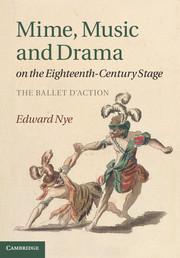
- Cover image
The Penn Libraries is committed to describing library materials using current, accurate, and responsible language. If you discover outdated or inaccurate language, please fill out this feedback form to report it and suggest alternative language.