3 options
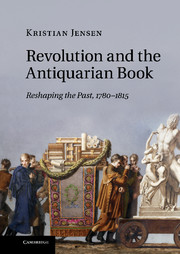
Revolution and the antiquarian book : reshaping the past, 1780-1815 / Kristian Jensen.
Van Pelt Library Z987.5.E85 J46 2011
Available
Kislak Center for Special Collections - Furness Shakespeare Library (Van Pelt 628) Z987.5.E85 J46 2011
Available
- Format:
- Book
- Author/Creator:
- Jensen, Kristian, 1954-
- Language:
- English
- Subjects (All):
- Book collecting--Social aspects--Europe--History--18th century.
- Book collecting.
- Book collecting--Social aspects--Europe--History--19th century.
- Incunabula--Collectors and collecting--Europe--History--18th century.
- Incunabula.
- Incunabula--Collectors and collecting--Europe--History--19th century.
- Antiquarian booksellers--Europe--History--18th century.
- Antiquarian booksellers.
- Antiquarian booksellers--Europe--History--19th century.
- Books and reading--Social aspects--Europe--History.
- Books and reading.
- Printing--Social aspects--Europe--History.
- Printing.
- Enlightenment--Europe.
- Enlightenment.
- Printing--Social aspects.
- History.
- Books and reading--Social aspects.
- Incunabula--Collectors and collecting.
- Book collecting--Social aspects.
- Europe.
- Europe--Intellectual life--18th century.
- Intellectual life.
- Physical Description:
- x, 318 pages : illustrations ; 26 cm
- Place of Publication:
- Cambridge ; New York : Cambridge University Press, 2011.
- Summary:
- "At the end of the eighteenth century, noblemen and revolutionaries spent extravagant sums of money or precious military resources competing to acquire old books, which until then had often been regarded as worthless. These books, called incunabula, achieved cultural and political importance as luxury commodities and as tools for mastering a controversial past. Men of different classes met in a new, shared marketplace, creating a competition for social authority, as books were no longer seen merely as sources of textual information but as a way of controlling the past in the service of contemporary concerns. The old books themselves were often changed to meet new expectations of what important historic objects should be. Focusing on Paris and London, but taking a resolutely pan-European view, this book examines the emergence of this commodity and of a new historical discipline created by traders and craftsmen"-- Provided by publisher.
- Contents:
- Introduction; 1. Enlightenment ideas and revolutionary practice: incunabula and freedom; 2. Aristocratic aspirations and the wartime market: competing for the past and the future; 3. An object-based discipline emerges: old books, new luxury; 4. Competing for authority: 'the insolence of English wealth'; 5. Commemorating and obliterating the past: 'old books, very displeasing to the eye'; 6. Conclusion.
- Notes:
- Includes bibliographical references (pages 270-310) and index.
- Local Notes:
- Acquired for the Penn Libraries with assistance from the Horace Howard Furness Memorial Fund.
- ISBN:
- 9781107000513
- 1107000513
- OCLC:
- 656774298
- Online:
- Cover image
- Contributor biographical information
- Publisher description
The Penn Libraries is committed to describing library materials using current, accurate, and responsible language. If you discover outdated or inaccurate language, please fill out this feedback form to report it and suggest alternative language.