1 option
German Soldier Newspapers of the First World War / Robert L. Nelson.
Van Pelt Library D632.5.G3 N45 2011
Available
- Format:
- Book
- Author/Creator:
- Nelson, Robert L., 1971- author.
- Series:
- Studies in the social and cultural history of modern warfare
- Studies in the Social and Cultural History of Modern Warfare
- Language:
- English
- Subjects (All):
- Germany. Heer.
- World War, 1914-1918--Press coverage--Germany.
- World War, 1914-1918.
- World War, 1914-1918--Social aspects--Germany.
- Soldiers--Germany--Social conditions--20th century.
- Soldiers.
- Soldiers--Germany--Attitudes--History--20th century.
- Fellowship--History--20th century.
- Fellowship.
- Male friendship--Germany--History--20th century.
- Male friendship.
- Germany. Heer--Military life--History--20th century.
- Germany.
- German newspapers--History--20th century.
- German newspapers.
- Journalism, Military--Germany--History--20th century.
- Journalism, Military.
- World War, 1914-1918--Journalism, Military--Germany.
- History.
- Social conditions.
- Physical Description:
- xii, 268 pages : illustrations ; 24 cm.
- Place of Publication:
- Cambridge ; New York : Cambridge University Press, 2011.
- Summary:
- "The literature on trench journalism is well-established for Britain and France during the First World War, but this book is the first systematic study in English of German soldier newspapers as a representation of daily life and beliefs on the front. Printed by and for soldiers at or near the front line these newspapers were read by millions of 'ordinary soldiers.' They reveal an elaborately defined understanding of comradeship and duty. The war of aggression, the prolonged occupation on both fronts, and the hostility of the local populations were justified through a powerful image of manly comradeship. The belief among many Germans was that they were good gentlemen, fighting a just war and bringing civilization to backward populations. This comparative study includes French, British, Australian, and Canadian newspapers and sheds new light on the views of combatants on both sides of the line"-- Provided by publisher.
- "Why do soldiers fight? Why did German soldiers follow orders throughout a seemingly endless war from 1914 to 1918? Did German soldiers really believe that they were waging a 'war of defence' while occupying foreign soil and populations? Were German soldiers atavistic nationalists or bitter pacifists? In other words, were these men perpetrators or victims? What was the postwar legacy of these soldiers' experiences for the dark events to come? Every major study of German soldiers in the First World War (and ninety plus years has produced a vast library) attempts to tackle most, sometimes all, of these questions. This book is no exception. I posit partial answers to all of these queries through my analysis of German soldier newspapers, printed at or near the front, by and for soldiers. I will show that this incredibly popular medium, bought and read by millions, provided 'ordinary soldiers' with a language of manly justification for the aggressive and occupational practices of the German army. The soldier newspapers largely bypassed the popular nationalist discourse, a troublesome category in the still 'young' Germany with its many 'ethnic' divisions and decentralised mass culture, and instead focused upon the ideal of comradeship. This comradeship involved both that among fellow soldiers with its associated concepts of what it meant to be a 'man,' as well as the idea of the German comrade, an honest, good gentleman, as a participant in an occupying, or 'colonizing,' force"-- Provided by publisher.
- Contents:
- Authorship, censorship, readership
- National culture, national cohesion
- Comradeship
- German comrades, Slavic women
- Occupation and justification
- Appendix: German soldier newspapers.
- Notes:
- Includes bibliographical references and index.
- ISBN:
- 9780521192910
- 0521192919
- OCLC:
- 691202244
- Online:
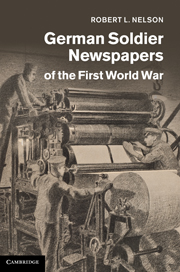
- Cover image
The Penn Libraries is committed to describing library materials using current, accurate, and responsible language. If you discover outdated or inaccurate language, please fill out this feedback form to report it and suggest alternative language.