1 option
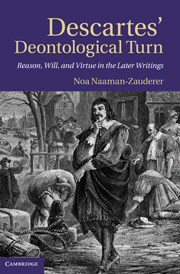
Descartes' deontological turn : reason, will, and virtue in the later writings / Noa Naaman-Zauderer.
- Format:
- Book
- Author/Creator:
- Naaman Zauderer, Noa.
- Language:
- English
- Subjects (All):
- Descartes, René, 1596-1650.
- Descartes, René.
- Will.
- Physical Description:
- xii, 224 pages ; 24 cm
- Place of Publication:
- Cambridge ; New York : Cambridge University Press, 2010.
- Summary:
- "This book offers a new way of approaching the place of the will in Descartes' mature epistemology and ethics. Departing from the widely accepted view, Noa Naaman-Zauderer suggests that Descartes regards the will, rather than the intellect, as the most significant mark of human rationality, both intellectual and practical. Through a close reading of Cartesian texts from the Meditations onward, she brings to light a deontological and non-consequentialist dimension of Descartes' later thinking, which credits the proper use of free will with a constitutive, evaluative role. She shows that the right use of free will, to which Descartes assigns obligatory force, constitutes for him an end in its own right rather than merely a means for attaining any other end, however valuable. Her important study has significant implications for the unity of Descartes' thinking, and for the issue of responsibility, inviting scholars to reassess Descartes' philosophical legacy"-- Provided by publisher.
- "This book offers a new way of approaching the place of the will in Descartes' mature epistemology and ethics. Departing from the widely accepted view, Noa Naaman-Zauderer suggests that Descartes regards the will, rather than the intellect, as the most significant mark of human rationality, both intellectual and practical. Through a close reading of Cartesian texts from the Meditations onward, she brings to light a deontological and non-consequentialist dimension of Descartes' later thinking, which credits the proper use of free will with a constitutive, evaluative role. She shows that the right use of free will, to which Descartes assigns obligatory force, constitutes for him an end in its own right rather than merely a means for attaining any other end, however valuable. Her important study has significant implications for the unity of Descartes' thinking and for the issue of responsibility, inviting scholars to reassess Descartes' philosophical legacy"-- Provided by publisher.
- Contents:
- Machine generated contents note: Preface; Abbreviations; Introduction; 1. Looking inward: truth, falsehood, and clear and distinct ideas; 2. Error in judgment; 3. Free will; 4. Free will and the likeness to God; 5. From intellectual to practical reason; 6. Descartes' deontological ethics of virtue; References; Index.
- Notes:
- Includes bibliographical references and index.
- ISBN:
- 9780521763301
- 0521763304
- OCLC:
- 635480151
- Online:
- Cover image
The Penn Libraries is committed to describing library materials using current, accurate, and responsible language. If you discover outdated or inaccurate language, please fill out this feedback form to report it and suggest alternative language.