1 option
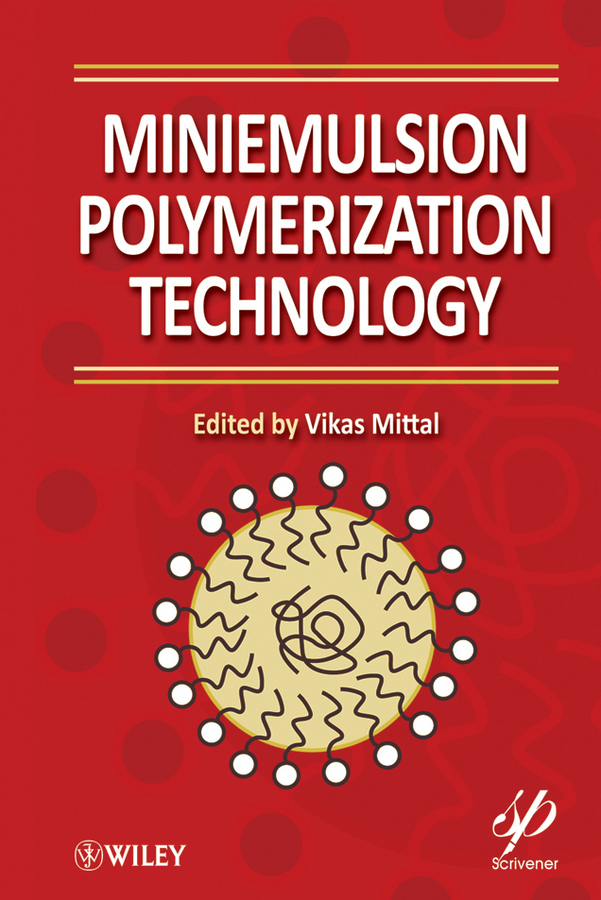
Miniemulsion polymerization technology / [edited by] Vikas Mittal.
LIBRA TP156.E6 M56 2010
Available from offsite location
- Format:
- Book
- Language:
- English
- Subjects (All):
- Emulsion polymerization.
- Microencapsulation.
- Nanoparticles.
- Physical Description:
- xiv, 311 pages : illustrations ; 25 cm
- Place of Publication:
- Salem, MA : Scrivener ; Hoboken, N.J. : Wiley, [2010]
- Summary:
- "Miniemulsion Polymeriziation Technology comprises 10 papers by many of the world's experts on the subject. It summarizes the recent advances in miniemulsion polymerization technology including the advances on the selection of surfactants and co-surfactants, the expansion of miniemulsion technology in various polymers and co-polymer systems, and the use of miniemulsion polymerization for the synthesis of advanced polymer particle morphologies. There have been a large number of texts on emulsion and other forms of polymerization methods, but miniemulsion polymerization, though it provides unique routes for polymer particle synthesis, has been neglected."-- Provided by publisher.
- Contents:
- 1 Miniemulsion Polymerization: An Overview / V. Mittal Mittal, V. 1
- 1.1 Introduction to Polymerization Techniques 2
- 1.2 Emulsion and Miniemulsion Polymerization 3
- 1.3 Properties of Miniemulsion Polymerization 10
- 1.4 Controlled Miniemulsion Polymerization 19
- References 22
- 2 Multi-Functional Stabilizers in Miniemulsion Polymerization / Alain Durand Durand, Alain 25
- 2.1 Introduction 25
- 2.2 Stability of Initial Monomer Droplets 27
- 2.3 Stabilizers and Polymerization Processes 30
- 2.3.1 Mass-Transfer Processes 30
- 2.3.2 Reactive Stabilizers 31
- 2.4 Conclusion 39
- References 39
- 3 Structured Copolymer Particles by Miniemulsion Polymerization / V. Mittal Mittal, V. 43
- 3.1 Introduction 43
- 3.2 Styrene-Dodecyl Methacrylate/Stearyl Methacrylate 46
- 3.3 n-Butyl Methacrylate-Crosslinking Monomers 49
- 3.4 Vinyl Acetate-Butyl Acrylate 51
- 3.5 Butyl Acrylate-(2-Methacryloxy)ethyl) trimethyl Ammonium Chloride 53
- 3.6 Butyl Acrylate-Methyl Methacrylate-Vinyl Acetate 54
- 3.7 Styrene-Acrylic Acid or 2-Aminoethyl Methacrylate Hydrochloride (AEMH) 55
- 3.8 Styrene-Butyl Acrylate 57
- 3.9 Styrene-Butadiene Rubber 57
- 3.10 Fluoroacrylate-Lauryl Methylacrylate-Methyl Methacrylate 61
- 3.11 Polyurethane-Block-Polystyrene 62
- 3.12 Alkyd-Acrylic 63
- 3.13 Oil-Acrylate 65
- 3.14 Urethane-Acrylic 67
- References 68
- 4 Encapsulation of Inorganic Nanoparticles by Miniemulsion Polymerization / Jacqueline Forcada Forcada, Jacqueline, Jose Ramos Ramos, Jose 71
- 4.1 Introduction 71
- 4.2 Miniemulsion Polymerization in the Presence of Inorganic Nanoparticles 73
- 4.2.1 Hydrophobization of Inorganic Nanoparticles 73
- 4.2.2 Dispersion of Hydrophobized Inorganic Nanoparticles in Monomer Phase 75
- 4.2.3 Miniemulsification of the Lipophilic Dispersion in Water 75
- 4.2.4 Polymerization of Droplets 76
- 4.3 Encapsulation of Silica Nanoparticles 76
- 4.3.1 Miniemulsion Polymerization with Hydrophilic Silica Nanoparticles 77
- 4.3.2 Miniemulsion Polymerization with Surface-Modified Silica Nanoparticles 78
- 4.3.3 Miniemulsion Polymerization with Locally Surface-Modified Silica Nanoparticles 83
- 4.4 Encapsulation of Magnetite Nanoparticles 85
- 4.4.1 Encapsulation of Magnetite by a Single Miniemulsion Polymerization Process 86
- 4.4.2 Encapsulation of Magnetite by a Double Miniemulsion Polymerization Process 89
- 4.5 Conclusions and Future Perspectives 91
- 4.6 Acknowledgements 92
- References 92
- 5 Polymeric Nanocapsules by Interfacial Miniemulsion Polymerization / Guo-Rong Shan Shan, Guo-Rong, Zhi-Hai Cao Cao, Zhi-Hai 97
- 5.1 Introduction 97
- 5.2 Organic Nanocapsules by Interfacial Miniemulsion Polymerization 99
- 5.2.1 Thermodynamic Prediction for the Morphology of Organic Nanocapsules 99
- 5.2.2 Particles Morphology of the System without Added NIPAM and DVB 101
- 5.2.3 Particles Morphology of the System with DVB 103
- 5.2.4 Particle Morphology of the System with Added NIPAM and DVB 105
- 5.2.5 Particle Size and Size Distribution in the Process of Polymerization 109
- 5.2.6 Mechanism for the Formation of Organic Nanocapsules through Interfacial Miniemulsion Polymerization 112
- 5.2.7 Influences on the Formation of Organic Nanocapsules through Interfacial Miniemulsion Polymerization 113
- 5.3 Organic-Inorganic Hybrid Nanocapsules by Interfacial Miniemulsion Polymerization 117
- 5.3.1 Thermodynamic Analysis and Morphological Prediction 117
- 5.3.2 Synthesis of Organic-Inorganic Hybrid Nanocapsules under Neutral Conditions 119
- 5.3.3 Synthesis of Organic-Inorganic Hybrid Nanocapsules under Acidic or Basic Conditions 124
- 5.3.4 Mechanism Analysis of Organic-Inorganic Hybrid Nanocapsules Formation 134
- 5.4 Conclusions 136
- References 137
- 6 Miniemulsion Polymerization of Vegetable Oil Macromonomers / Shelby F. Thames Thames, Shelby F., James W. Rawlins Rawlins, James W., Sharathkumar K. Mendon Mendon, Sharathkumar K. 139
- 6.1 Introduction and Background 139
- 6.2 Emulsion Polymerization of Alkyds and Vegetable Oils 143
- 6.3 (Meth)acrylated Vegetable Oil Derivatives 145
- 6.4 Vegetable Oil Macromonomers 146
- 6.5 The Potential for Emulsion Polymerization of Model Saturated Monomers 150
- 6.6 Nucleation Mechanisms 152
- 6.7 Design of Thermosetting Latex Polymers 154
- 6.8 Classifying Monomer Solubility for Macro and Miniemulsion Polymerization 158
- 6.9 Soybean Acrylated Monomer Synthesis 160
- 6.10 Miniemulsion Polymerization 160
- 6.11 Conclusions 168
- References 169
- 7 Controlled/Living Radical Polymerization in Aqueous Miniemulsion / Catherine Lefay Lefay, Catherine, Julien Nicolas Nicolas, Julien 173
- 7.1 Introduction 174
- 7.2 Controlled/Living Radical Polymerization in Bulk/Solution: General Considerations 174
- 7.2.1 CLRP Based on Reversible Termination 175
- 7.2.1.1 Nitroxide-Mediated Polymerization (NMP) 176
- 7.2.1.2 Atom Transfer Radical Polymerization (ATRP) 177
- 7.2.2 CLRP Based on Degenerative Transfer 178
- 7.2.2.1 Reversible Addition-Fragmentation Chain Transfer (RAFT) 179
- 7.2.2.2 Iodine Transfer Polymerization (ITP) 180
- 7.3 Nitroxide-Mediated Miniemulsion Polymerization 182
- 7.3.1 Oil-Soluble Bicomponent Initiating System 183
- 7.3.2 Water-Soluble Bicomponent Initiating System 185
- 7.3.3 Oil-Soluble Monocomponent Initiating System 186
- 7.3.4 Water-Soluble Monocomponent Initiating System 188
- 7.4 Atom Transfer Radical Miniemulsion Polymerization 188
- 7.4.1 Direct ATRP 190
- 7.4.2 Reverse ATRP 190
- 7.4.3 Simultaneous Reverse and Normal Initiation (SR&NI) ATRP 192
- 7.4.4 Activators Generated by Electron Transfer (AGET) ATRP 192
- 7.5 Reversible Addition-Fragmentation Chain Transfer Miniemulsion Polymerization 193
- 7.5.1 Key-Steps for the Success of RAFT Miniemulsion Polymerization 194
- 7.5.1.1 Inhibition and Retardation 194
- 7.5.1.2 Colloidal Instability 196
- 7.5.1.3 Livingness and Controlled Polymerization 198
- 7.5.2 RAFT Miniemulsion Polymerization of Vinyl Acetate 199
- 7.5.3 Nanocapsules Synthesized by RAFT Miniemulsion Polymerization 200
- 7.6 Iodine Transfer Polymerization in Miniemulsion 201
- 7.7 Conclusion 202
- References 203
- 8 Inverse Miniemulsion Polymerization of Unsaturated Monomers / Ignác Capek Capek, Ignác 211
- 8.1 Introduction 211
- 8.2 General 215
- 8.3 Kinetic Studies 218
- 8.4 Traditional and Nonconventional Inverse Latexes 221
- 8.4.1 Water Soluble Monomers 221
- 8.4.2 Hydrophobic Monomers 230
- 8.5 Controlled Radical Miniemulsion Polymerization 232
- 8.6 Amphiphilic and Associating Copolymers 237
- 8.7 Conclusion 240
- 8.8 Acknowledgements 244
- Abbreviations 244
- References 246
- 9 Double Miniemulsion Preparation for Hybrid Latexes / R.Y. Hong Hong, R.Y., G. Liu Liu, G., B. Feng Feng, B., H.Z. Li Li, H.Z. 251
- 9.1 Introduction 252
- 9.2 Hybrids via Mini-Emulsion Polymerization 253
- 9.3 Double-Miniemulsion Formation 255
- 9.4 Stability 255
- 9.5 Characterization 257
- 9.6 Applications 261
- 9.6.1 Effects of Reaction Conditions 266
- 9.6.1.1 Initiator Dosage 266
- 9.6.1.2 MMA Monomer Concentration 267
- 9.6.2 Rheological Properties of Magnetic Emulsion 268
- 9.6.2.1 Viscosity Versus Time 268
- 9.6.2.2 Viscosity with/without Magnetic Field 269
- 9.6.2.3 Applications of Magnetic Polymer Microspheres 270
- 9.7 Summary 271
- 9.8 Acknowledgments 272
- References 272
- 10 Surfactant Effect in Miniemulsion Polymerization for Biodegradable Latexes / V. Soldi Soldi, V., B.G. Zanetti-Ratnos Zanetti-Ratnos, B.G., E.
- Minatti Minatti, E. 277
- 10.1 Introduction 277
- 10.2 Miniemulsion Polymerization of Biodegradable Latexes 278
- 10.3 Mechanisms of Surfactant Protection of Colloidal Dispersions 282
- 10.3.1 General Behavior of a Surfactant Molecule at the Interface 282
- 10.3.2 Mechanism 1: Lowering the Interfacial Tension 284
- 10.3.3 Mechanism 2: Electrostatic Stabilization 286
- 10.3.4 Mechanism 3: Steric Stabilization 288
- 10.4 Effect of Surfactants on Miniemulsion Polymerization 291
- 10.4.1 Effect of Surfactant Type on the Particle Size and Latex Yield 291
- 10.4.2 Effect of Surfactant Concentration on Particle Size and Latex Yield 294
- 10.4.3 Effect of Surfactant on the Stability 297
- 10.5 Final Remarks 298
- References 299.
- Notes:
- Includes bibliographical references and index.
- ISBN:
- 9780470625965
- 0470625961
- OCLC:
- 567008071
- Online:
- Cover image
The Penn Libraries is committed to describing library materials using current, accurate, and responsible language. If you discover outdated or inaccurate language, please fill out this feedback form to report it and suggest alternative language.